

By: Rees Hakeem Oduro
Ghana stands at the threshold of a promising agricultural and industrial revolution—one powered by hemp, the ‘green gold’ offering an immense economic potential. As the global community increasingly recognises hemp’s immense economic, environmental, and medicinal value, Ghana has taken a bold step by establishing the legal framework to participate in this fast-growing industry. Ghana’s Minister for the Interior, Muntaka Mohammed Mubarak, on Thursday, 26 February 2026, launched the country’s Industrial and Medicinal Cannabis Programme as mandated by the Narcotics Control Commission Act 2020 (Act 1019) as amended. The programme, according to the Minister, is a move aimed at increasing economic development while promoting public safety. Therefore, every Ghanaian (farmers, investors, policymakers, health practitioners and consumers) has a stake in understanding and embracing this opportunity.
Understanding Hemp: What it is and What it is Not
Hemp is defined as a non-psychoactive variety of cannabis containing not more than 0.3% tetrahydrocannabinol (THC), the compound responsible for the “high” associated with marijuana. This distinction is vital in understanding Ghana’s Cannabis Programme. Unlike marijuana, with THC levels between 15% –30%, producing immense psychoactive effects, hemp cannot produce intoxicating effects when used. It is cultivated primarily for industrial, nutritional, and medicinal purposes.
Public education on this distinction is crucial. Misinformation about hemp could hinder the success of an industry that could greatly boost Ghana’s economy and cause needless stigma and legal implications if hemp and marijuana are confused.
Ghana’s Legal Foundation for the Hemp Industry
Ghana has already laid the foundation for a regulated hemp industry. The Narcotics Control Commission (Amendment) Act, 2023 (Act 1100) empowers the Minister for the Interior, in consultation with the Narcotics Control Commission (NACOC), to issue licenses to individuals and organisations seeking to participate in the hemp value chain. This legal certainty gives researchers, investors and business owners the assurance they need to explore hemp production, processing, and cultivation in a regulated legal environment.
Medicinal Potential of Hemp
Cannabidiol (CBD), one of hemp’s non-psychoactive components, has substantial medical significance. Globally, products made from hemp are being researched and used for various therapeutic purposes, such as the relief of chronic pain and inflammation, epileptic treatment, anxiety and stress-related management, supportive care in some neurological disorders, and skin healthcare, among others. The therapeutic potential of hemp-based products is indisputable, and they represent a significant area for the exploration of Ghana’s pharmaceutical and herbal medicine industries; however, further research and appropriate regulation are required.
Hemp Seeds, a Nutritional Powerhouse
Hemp seeds are among the most nutritionally packed plant foods available. Available studies indicate that hemp seeds are rich in an optimal ratio of Omega-3 and Omega-6 fatty acids. This optimal balance, together with Gamma-linolenic acid (GLA—one of the main chemicals in breastmilk), supports cardiovascular health, reduces inflammation and contributes to the general well-being of the immune system. Hemp seeds are also a rich source of high-quality plant protein and essential vitamins and minerals. Incorporating hemp seeds into Ghana’s food systems could improve nutrition, support local food industries, and create new agro-processing opportunities.
Industrial and Environmental Uses
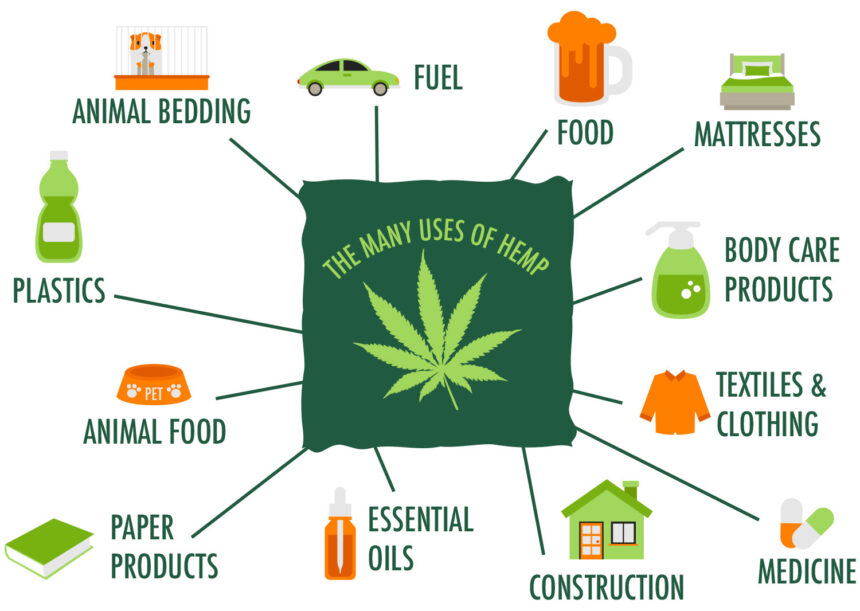
One of hemp’s greatest benefits is its different uses across multiple industries. It is one of the most versatile and sustainable crop species worldwide. Hempfoundation.net lists about two hundred and forty-nine (249) uses of hemp. Hemp fibre is strong, durable and environmentally friendly for textiles and clothing production. Hemp clothing can be an affordable alternative to wool and silk. This use of hemp fibre can significantly support Ghana’s textile and garment industry while reducing the over-reliance on synthetic fibres and materials.
In construction, hemp-based building materials such as hemp bricks and hempcrete are lightweight, breathable and environmentally friendly. They are known to regulate indoor humidity and temperature. Hemp-based building materials offer potential for affordable green housing solutions for Ghana’s local real estate development.
Hemp is also useful in energy production. Hemp biomass can be converted into methanol and other biofuels. Studies show that hemp produces more ethanol per acre than corn, making it a more efficient source. Unlike gasoline, hemp does not produce sulfur emissions, making it an effective source of renewable energy initiative.
Hemp can also promote the local paper industry. It produces high-quality paper and packaging materials with less environmental degradation than traditional wood pulp. Unlike paper from wood pulp, hemp paper does not require chemical treatment and lasts for many years without yellowing. Using hemp for paper can be more sustainable than wood pulp because it produces four times more fibre per acre than trees, and also reduces deforestation.
In the cosmetics industry, hemp is equally useful. Hemp-derived essential oils are widely used in skincare, wellness products, and household goods, opening manufacturing opportunities for local industries. From the production of face masks, lip balms, sunscreen, anti-ageing serum, beard oil, shampoos, soaps, and toothpastes, among others, hemp can be essential in the development of Ghana’s small and medium-scale industries.
Soil Restoration and Phytoremediation: Hemp is known for its ability to improve soil health and absorb certain contaminants from the environment. Hemp roots are known for their ability to absorb toxic metals, including lead, mercury and cadmium. Its use in phytoremediation makes it valuable for reclaiming degraded lands resulting from galamsay activities and supporting sustainable agriculture in the country.
Economic Gains for Ghana
If properly developed, the hemp industry could create jobs across agriculture, processing, manufacturing, and retail. The Cannabis programme will also attract foreign direct investment and boost export earnings. The programme will also help revitalise the textile and paper industries. It will also support rural economic development by providing an alternative source of livelihood for farming communities. Additionally, it will provide an opportunity for the growth of Ghana’s pharmaceutical and nutraceutical sectors. Countries that moved early into the cannabis programme have already built billion-dollar industries. Ghana has the climate, the agricultural base, and now the legal framework to compete.
The Critical Need for Strict Monitoring
While the opportunities are enormous, responsible regulation is non-negotiable. Hemp (≤0.3% THC) must never be allowed to become a cover for the cultivation or distribution of psychoactive cannabis. Without strict monitoring, the industry could face public health risks, reputational damage, and possible international compliance concerns. The government, through NACOC, should safeguard the programme through strict monitoring regulations coupled with extensive registration requirements and fees to prevent unscrupulous people from joining the programme. Key safeguards should include rigorous licensing and vetting of operators, regular testing of crops to determine their THC levels at every stage of their growth. There should also be a strong field inspection regime and a secure seed certification system. In addition, systems should be in place to enable clear traceability across the supply chain. Public education to prevent misuse and misinformation should be intensified. A well-regulated programme will protect public health while allowing legitimate businesses to thrive.
In conclusion, the Cannabis Programme is a national opportunity that should be embraced. It represents a rare convergence of agriculture, health innovation, environmental sustainability, and industrial growth. With the passage of the Narcotics Control Commission Act 2020 (Act 1019) as amended, Ghana has positioned itself to participate in a global market that continues to expand. However, its success will depend on informed public support, responsible investment, strict regulation, and continuous public sensitisation to distinguish industrial hemp from psychoactive marijuana. With proper management, hemp has the potential to grow into one of the most valuable green commodities in the nation, promoting job creation, economic diversification, and sustainable national growth.
The time to embrace hemp is now.
Rees Hakeem Oduro (reeskofi@gmail.com)
Silver Spring, Pedu
Cape Coast
Disclaimer
The views expressed are solely those of the author and do not reflect the official position of any state agency, organisation, institution or media house with which the author may be affiliated.