
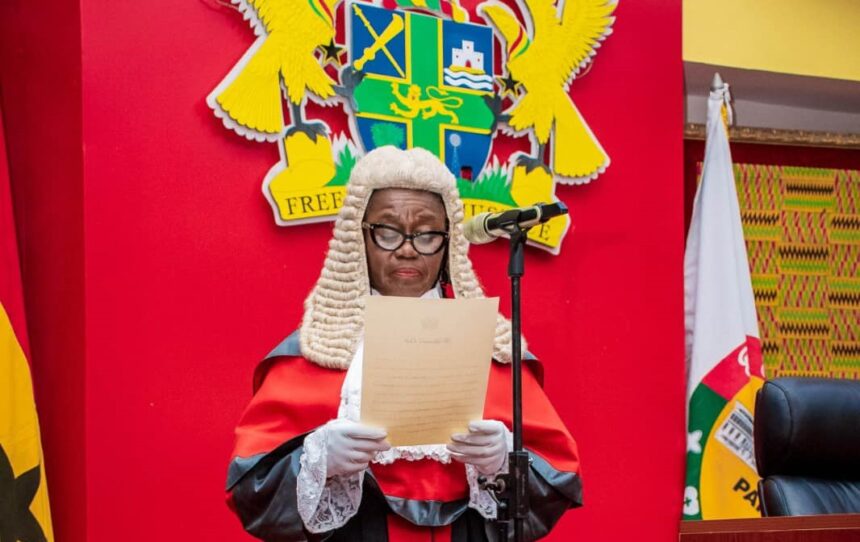

In a country where the judiciary is often seen as the last bastion against the whims of political power, the revelation that more than half of Ghanaian voters support the removal of the sitting Chief Justice, Gertrude Araba Esaaba Sackey Torkornoo, is nothing short of seismic. According to a recent poll conducted by Global InfoAnalytics, 52% of respondents back her removal, while only 20% oppose it. The numbers speak volumes—not just about one individual but about the eroding trust in a system designed to protect the Constitution and the conscience of the Republic.
This poll is not merely a temperature check of public opinion; it is an X-ray into a nation’s soul. From Greater Accra to the Northern Region, the majority sentiment coalesces around a desire for judicial change. With the exception of Ahafo and Upper East, every region leans toward supporting her ousting. Even among the educated elite, who are typically more cautious in assessing constitutional matters, the data is unequivocal: 54% of those with tertiary education say she must go. These are not murmurs of dissent; they are alarms ringing from the corridors of everyday Ghanaian life.
Yet such numbers, however compelling, must be interpreted with analytical sobriety. Public disapproval, no matter how widespread, cannot and must not be the metric for evaluating a judge’s tenure. The judiciary is not a popularity contest. Its independence is both shield and sword against the tides of partisan retribution. The notion that a Chief Justice could be removed—or even pressured to resign—based on fluctuating public sentiment opens a dangerous floodgate. Today it may be Gertrude Torkornoo; tomorrow it could be any judge whose ruling displeases the mob.
The methodology of the survey was robust. A nationally representative sample of 2,545 voters, a confidence level of 99%, and a margin of error of just ±1.51%—these are hallmarks of statistical credibility. The survey also used a mixed method of live computer-assisted interviews, not mere online clicks or social media noise. In effect, this wasn’t a fluke or a Twitter campaign. It was a scientifically executed inquiry into public opinion. But opinion is not fact, and in matters of law, emotion cannot supplant evidence.
Still, what cannot be ignored is the depth of the perception crisis. Why does a majority of Ghanaians—from all education levels and most regions—want the Chief Justice removed? Is it based on specific rulings, allegations of misconduct, or a broader sense of institutional decay? The data does not answer that, but its implications are profound. If the perception of bias or ineffectiveness is this widespread, it could hamper the judiciary’s ability to enforce its rulings, especially in politically charged cases such as electoral disputes.
There is also a political undercurrent. Among known opposition (NDC) supporters, a staggering 83% favor her removal. Among ruling NPP voters, only 16% share that view. The judiciary, therefore, is not only on trial in the court of public opinion; it is also being dragged through the trenches of Ghana’s polarized politics. This kind of partisan perception corrodes not only the reputation of individual justices but the very legitimacy of the legal system.
To defend the judiciary is not to immunize it from criticism. Judicial officers, like all public servants, must be held accountable. But accountability must be rooted in due process, not populist whims. It is the role of Parliament, through impeachment proceedings backed by verifiable wrongdoing, to trigger removal—not a national poll.
Still, those defending the Chief Justice must take heed of the groundswell. These are not just numbers—they are signs. Signs of a people whose faith in the institutions that govern them is faltering. Signs that Ghana must re-invest in civic education, judicial transparency, and institutional independence.
The Chief Justice may survive this moment. But the judiciary, once stripped of moral credibility, may not. And when that happens, it is not the judges who will suffer most—but the democracy they are sworn to protect.