
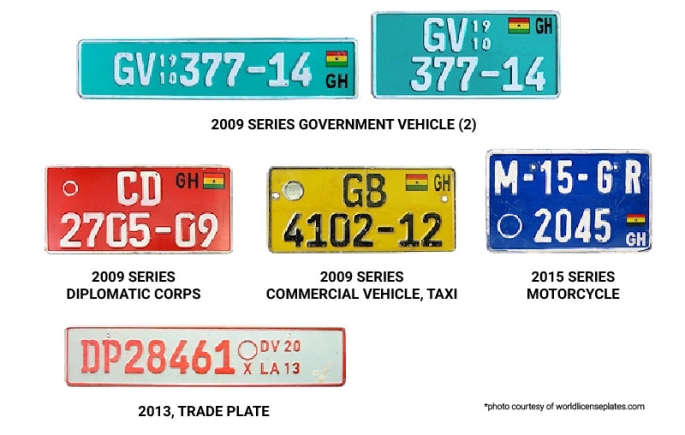

Ghanaian vehicle number plates have been using the current system since January 2009, which features a two-letter region code, followed by a four-digit numeric code, and a two-digit year code. But the Driver and Vehicle Licensing Authority (DVLA) has said it will abolish displaying the year of registration on vehicle number plates from January 1, 2026.
The new system, according to the Chief Executive of the DVLA, Julius Neequaye Kotey will instead only identify vehicles by the region in which they were registered for example “Greater Accra” written on top of the plate, followed by the vehicle’s unique four-digit number and a code showing the zone within which the vehicle was registered
For example, a vehicle registered within the Adenta zone in Greater Accra will have “AD” code at the end of the four-digit unique number, replacing where the year of registration, for example, “25” would have been displayed.
Mr Julius Neequaye Kotey disclosed this during a television interview with Channel One TV on the programme Face to Face aired on Tuesday, August 19, 2025, and monitored by Graphic Online.
He said the change will introduce regional names at the top of plates, followed by area codes showing which DVLA office processed the registration.
According to Mr Kotey, Ghana is the only country in the world that displays the year of registration on vehicle plates.
“There is no country in the world that puts year at the end [of the plate],” he said.
“When you go to the US, the UK or Germany, there is no single country that does this,” he said.
Under the new system, a Greater Accra plate would display “Greater Accra” at the top, with “GR 2224-AD” below, where GR represents Greater Accra Region and AD shows the Adenta office. An Ashanti Region plate would bear “Ashanti” on top and follow the format “AS 3520-KM”, with AS for Ashanti and KM representing Kumasi.
“Every region will have the name on top of it,” Mr Kotey explained. “So Greater Accra, the region code of Greater can be GR. After that, where the year of registration used to be, will now be the area code.”
When asked if the reform would make it easier to trace vehicles involved in crimes, Mr Kotey said specific plate identification was more effective than year-based descriptions.
“If you tell me someone has done a hit and run and the car is 2025 registered, there are a lot of 2025 cars in the system. How will I know the car? If you give the exact number, it is easier for DVLA to identify the person.”
Mr Kotey said the change is also aimed at curbing registration avoidance, which he said has resulted in many people opting to use the “DV” plates for private use and driving in town.“Because of the year, some people are unwilling to register their cars,” he said.
According to him, this is to help prevent and limit the use of “DV” [Defective Vehicle] plates in the system, which ordinarily is supposed to be used by car dealers for specific reasons, when they only need to move the vehicle to a specific location for repairs or for a test drive for a potential buyer.
However, he said many private individuals are reluctant to register their vehicles and have been resorting to the use of DV plates all year round.
The implementation of the new proposal requires parliamentary approval to amend Legislative Instrument 68, which governs the Road Traffic Regulation. “We’ve done all the legal work. We need to amend LI 68, the road traffic regulation, and parliament is ready to approve it for implementation from January 2026,” Mr Kotey said.