
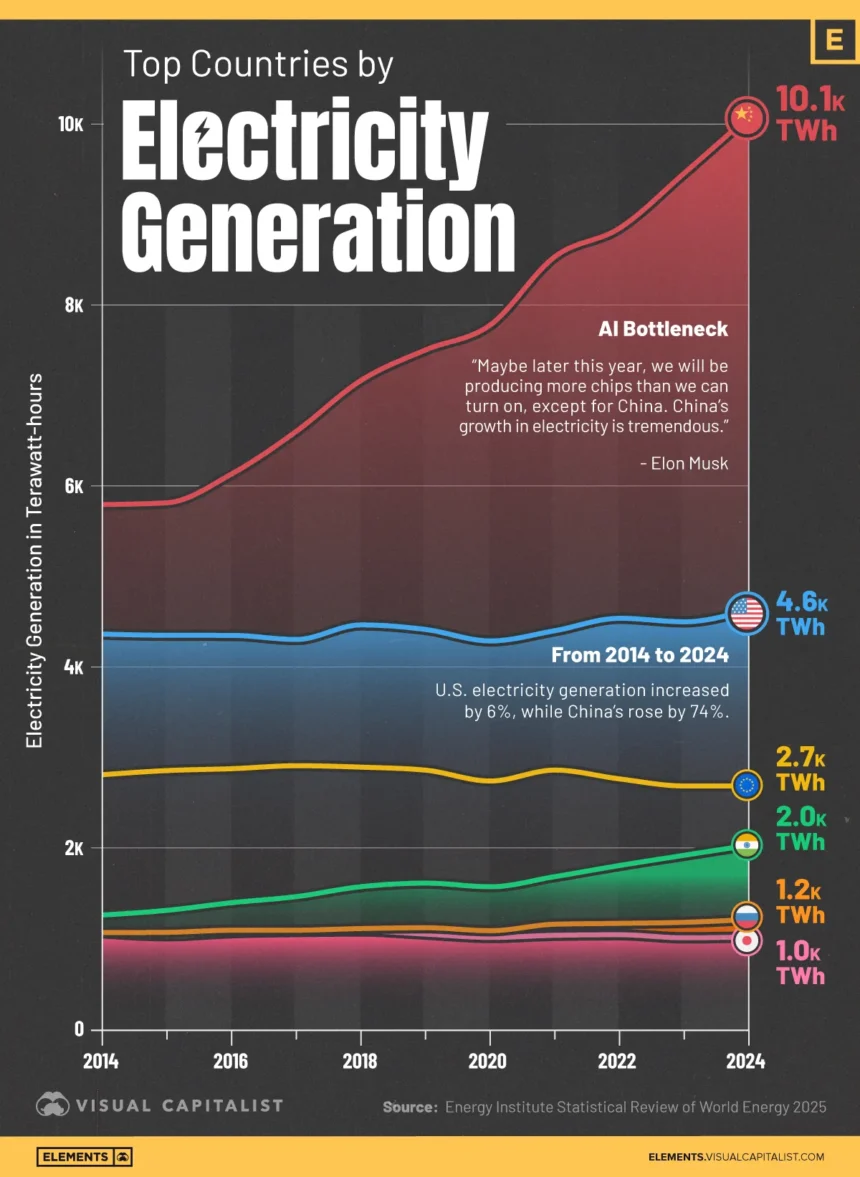

Global electricity demand is accelerating—powered by electrification, industrial growth, and the explosive expansion of AI data centers.
But one country has pulled dramatically ahead.
China now generates more than double the electricity of any other nation on Earth.
This chart tracks electricity generation by country from 2014 to 2024, highlighting China’s extraordinary rise. The data for this visualization comes from the Energy Institute’s Statistical Review of World Energy.
China Pulls Away From the Pack
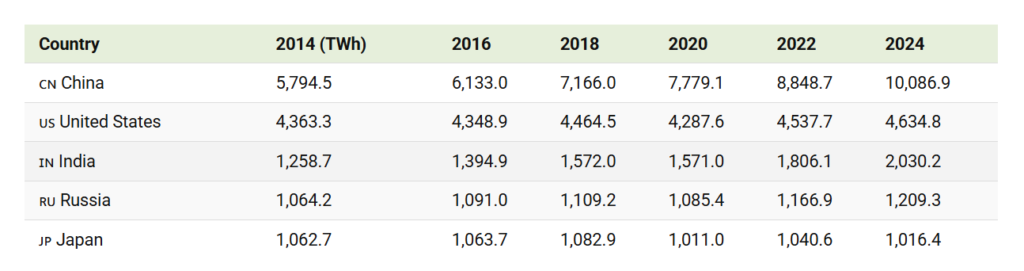
In 2014, China generated roughly 5,795 TWh of electricity, already more than the United States. By 2024, that figure had climbed to 10,087 TWh—a 74% increase in just 10 years. Over the same period, U.S. generation edged up from 4,363 TWh to 4,635 TWh, a comparatively modest 6% rise.
In 2024, China generated more than twice as much power as the United States and nearly five times as much as India.
This rapid expansion reflects China’s industrial scale, urbanization, and leadership in manufacturing.
China’s abundant and relatively low-cost electricity supply is increasingly seen as a strategic advantage, particularly as AI models and data centers require enormous amounts of power.
Speaking at the World Economic Forum in Davos, Switzerland, U.S. tech billionaire Elon Musk suggested that the world could soon produce more semiconductor chips than it has the power to run—except in China. “China’s growth in electricity is tremendous,” he said, highlighting the country’s expanding energy capacity as a strategic advantage
India’s Steady Climb
India is the only other major economy showing sustained, high growth. Electricity generation rose from 1,259 TWh in 2014 to over 2,030 TWh in 2024—an increase of more than 60%.
While still far below China’s level, India’s trajectory mirrors its economic expansion and rising energy demand from a growing middle class.
Flat or Declining Output in Russia and Japan
Rounding out the top four are Russia and Japan, though their growth stories look very different from China and India. Russia’s electricity generation increased modestly from 1,064 TWh in 2014 to 1,209 TWh in 2024, reflecting gradual industrial and export-driven demand.
Japan, by contrast, has seen largely flat output over the past decade. Generation stood at 1,063 TWh in 2014 and was 1,016 TWh in 2024, with fluctuations in between. Slower economic growth, demographic headwinds, and shifts in its energy mix have all contributed to relatively stagnant power demand.
Source: visualcapitalist.com