
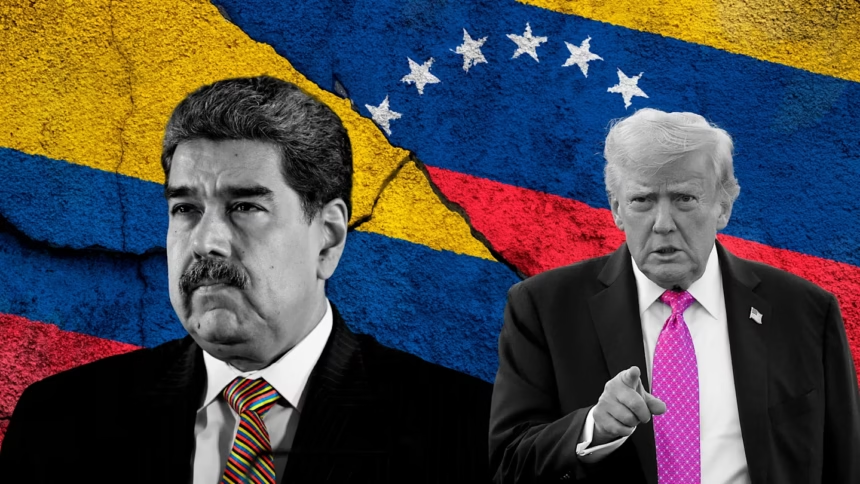

Nicolás Maduro’s dramatic capture wasn’t just a military operation; it was an inside job. Reports confirm the U.S. strike succeeded with astonishing ease because Maduro was likely sold out by the very men he trusted most—his “kitchen cabinet” like the powerful Diosdado Cabello and military chief Vladimir Padrino López. They condemned the attack, but their words rang hollow as the Venezuelan military offered no real resistance.
For years, the U.S. even tried to turn Maduro’s own pilot against him, offering millions for his betrayal. This is the ultimate political rule: your inner circle holds the keys to your survival, and sometimes, they auction those keys to the highest bidder.
History’s Greatest Men Have Been Brought Low by Their Brothers-in-Arms
Maduro is not an exception. He is the latest name on a long, dark list of leaders who trusted a friend and found an executioner.
· Julius Caesar & Brutus: The most famous betrayal in history. Caesar, the all-powerful Roman dictator, was stabbed to death in the Senate by a group of senators led by Marcus Brutus, a man he had forgiven, promoted, and considered an ally. His legendary last words, “Et tu, Brute?” (And you, Brutus?), echo through the ages as the ultimate cry of betrayed trust.
· George Washington & Benedict Arnold: Before his name became synonymous with “traitor,” Benedict Arnold was one of General Washington’s most talented and trusted generals. Bitter over perceived slights and drowning in debt, he secretly agreed to hand over the critical fort at West Point to the British. His plot was uncovered, but his betrayal shattered Washington and remains America’s original sin of treachery.
· Thomas Sankara & Blaise Compaoré (Africa’s Heartbreaking Betrayal): Look no further than Africa for the most poignant example. Thomas Sankara, the revolutionary “Lion King” of Burkina Faso, was a visionary leader of integrity. His closest friend, confidant, and right-hand man was Blaise Compaoré. In 1987, Compaoré led the coup that assassinated Sankara, personally ordering the murder of his brother to seize power. Sankara was a threat to foreign interests and Compaoré’s personal ambition, so the friend became the assassin. This is the textbook betrayal for personal gain.
The moral is brutal and clear: Proximity is not loyalty. The allies who stand to gain the most from your fall are often the ones standing closest to you, smiling. They know your routines, your secrets, and your weaknesses. They are the ones whose betrayal is not just possible but devastatingly effective.
Today, it is Maduro, humiliated and facing trial, because his inner circle chose self-preservation over loyalty.
Who is next?
The wheel of betrayal never stops turning. Look around you. Look at your own inner circle. And be wise.