
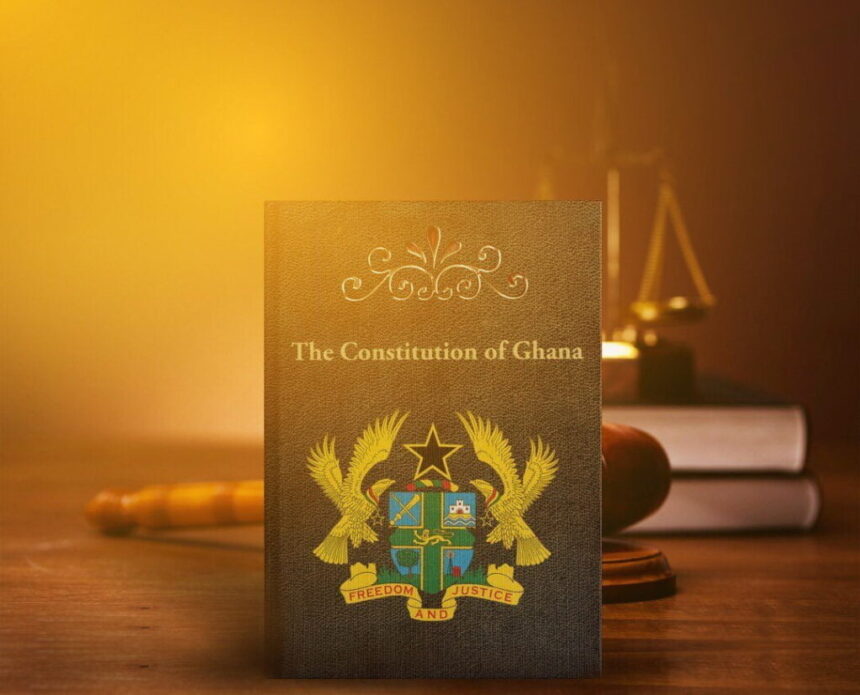

The NDCs quietly dubious Re-Engineeringing of a Third Term for Mahama? The Curious Case of Ghana’s Constitutional Review
You look at the list of proposed constitutional reforms and feel the warmth of progress: a five-year presidential term, ministers out of Parliament, stricter public appointment rules, electrifying talk of decentralisation, binding processes for censure, and stronger conflict-of-interest rules. On paper, it reads like constitutional maturity. But in the corners of Ghana’s political street, a darker tune is playing.
If Majority Leader Mahama Ayariga was so casual in Parliament when he said “Ghanaians are asking President Mahama to continue,” one might think he was quoting the spirit of the nation. Yet the minute those words hit the airwaves, every centre-right ear in Accra pricked up. Because history in Africa shows that when leaders do not openly ask to extend their stay in office, clever politics usually does it for them.
Let us not be naïve. The Constitutional Review Committee has been clear that it did not recommend a third term. Its chairman, Professor Henry Kwasi Prempeh, a passionate idealist has said there was no public demand for it and that the President himself had no interest. That is the official story. But He is working for hardened politicians, and constitutions are not undone by official stories from idealists. They are undone by patterns, timing, and behaviour of desperately wicked politicians.
Here lies the first problem. Extending the presidential term from four to five years sounds harmless, even smart. It is sold as global best practice and as giving leaders more time to deliver. But changing the rhythm of accountability is never neutral. It stretches the distance between the voter and power. It slows political correction. In young democracies, time is power.
Ask the harder question. Why now? Ghana has lived with the 1992 Constitution for over thirty years. Its flaws are well known, but its core strength has been clear limits on power and regular change through elections. Suddenly, under one parliamentarily dominant political moment, we are rushing through reforms that reshape political authority rather than simply fixing administrative gaps. When reform begins to consistently favour continuity and executive comfort over the rule of law and independent institutions scepticism becomes common sense.
This is not theory. Africa has watched this play out repeatedly.
In Côte d’Ivoire, a new constitution in 2016 quietly reset the political clock. Alassane Ouattara did not announce a third term at first. The constitution did the work. He ran again, then again. Opposition was squeezed out, turnout fell, and the country entered a cycle of tension no one voted for.
Uganda removed term limits, then removed age limits. Cameroon scrapped limits altogether. Burundi reset limits through constitutional change, triggering violence and mass displacement. Rwanda used a new constitutional order to justify a reset of presidential time. In Guinea, similar manoeuvres ended not in reform but in instability and military takeover. None of these began with a loud declaration of lifelong rule. They began with technical adjustments, national conversations, and assurances that there was nothing to fear.
This is why Ayariga’s statement matters. When a Majority Leader says the people want continuity, without an election, without a referendum, and without evidence, it stops sounding like opinion and starts sounding like preparation.
Supporters will argue that Ghana is different. That our institutions are stronger. That the reforms include good things like decentralisation, binding censure, independent salary commissions, and public participation in law-making. All true. But when we are watching the systematic dismantling of our institutions by the NDC, then politics is not judged by individual clauses. It is judged by cumulative effect.
Now comes the deeper concern that many Ghanaians are whispering but few are saying loudly. Trust.
How can a president and a party that, in just one year, have repeatedly strained Ghana’s internationally recognised democratic credentials suddenly ask for blind trust when it comes to amending the supreme law of the land?
This is not about insults. It is about record.
John Mahama and the NDC have shown, through actions not slogans, a troubling comfort with executive dominance. From open attempts to politisize and weaken independent institutions to a visible appetite for controlling the Electoral Commission, the judiciary, and accountability offices, the pattern is familiar. It echoes an older political instinct that many Ghanaians hoped had been buried.
Mahama has never hidden his admiration for the CPP & PNDC era, a period during which his family rose to prominence. That era was not known for pluralism, free markets, or open dissent. It was known for one-party rule in practice, state control of the economy, suppression of the press, and fear dressed up as discipline. It is also not a secret that similar political models in parts of the Sahel and in Côte d’Ivoire appear to hold appeal within sections of today’s NDC thinking.
This is where history refuses to stay quiet.
From Nkrumah to Acheampong to Rawlings, Ghana’s darkest democratic moments followed the same script. Power concentrated, constitutions amended, courts weakened, media silenced, and the private sector pushed aside for state control and political patronage. Nkrumah began as a democratically elected leader. He ended as president for life after sacking the Chief Justice, changing the constitution, and dismantling opposition. Acheampong’s so-called Unigov suffocated freedoms. Rawlings ruled for years under military-backed one-party dominance, with detention without trial, fear, and the collapse of Ghanaian private enterprise.
The claim that the NDC gifted Ghana the 1992 Constitution is, at best, selective memory. That constitution was not born out of generosity. It was wrestled from a military regime under heavy international pressure, much of it driven by exiled members of the Danquah-Busia tradition. The freedoms Ghanaians now enjoy, press freedom, property rights, independent institutions, private sector leadership, human rights protections, were ideas fought for by people who were jailed, exiled, or killed for resisting authoritarianism.
Many of the defects in the 1992 Constitution are not accidents. They are remnants of a reluctant transition from PNDC rule, designed to keep executive power strong even in civilian clothing.
So when Mahama and the NDC talk about “resetting Ghana,” the honest question is this. Resetting to which chapter of our history?
If trust is what they seek, trust must first be earned through action. Undo the damage already done to constitutional order. Restore respect for independent institutions. End selective justice. Allow due process to breathe. Stop the quiet intimidation of critics. Halt the march toward capturing the Electoral Commission and the judiciary. Be transparent about political financing and the use of state resources. Let accountability apply evenly, not only to opponents.
Until then, calls for constitutional reform, no matter how polished, will sound less like national renewal and more like political engineering.
The most dangerous power grabs never announce themselves. They arrive wrapped in reform, defended by technical language, and justified by claims that the people want continuity. By the time the question is finally asked, the answer has already been designed.
In Ghana today, the question is no longer whether a third term is being discussed openly. It is whether we are quietly building the architecture that will one day make it sound reasonable.
History suggests that once that architecture is complete, dissent begins to sound like rebellion, and elections begin to feel optional.
That is how republics drift. Not with noise, but with comfort.


