
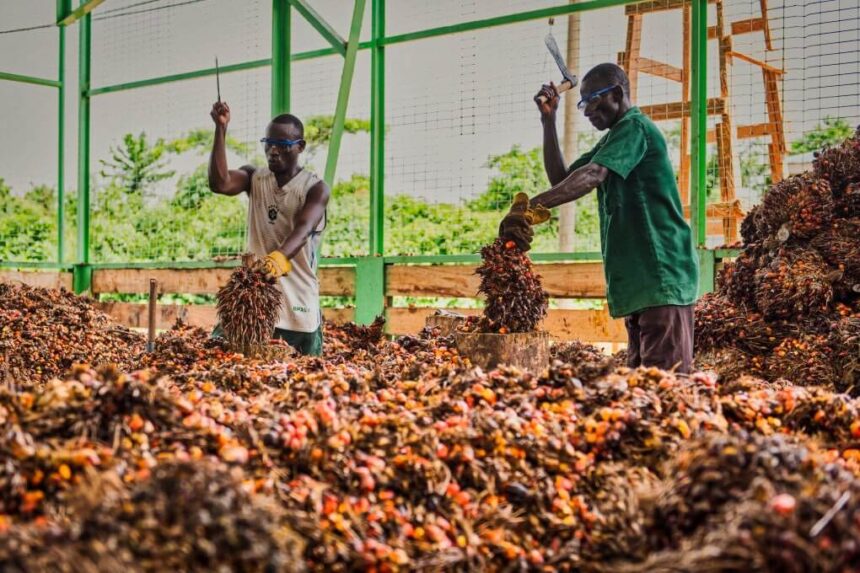

ACCRA — In the lush, tropical belts of Ghana’s Ashanti and Western regions, the harvest should be a celebration. Instead, it has become a funeral for the local economy. Between the final quarter of 2025 and the opening weeks of 2026, Ghana’s oil palm sector—once hailed as the “red gold” of West Africa—has spiraled into a state of structural decay.
A lethal combination of an unchecked smuggling epidemic and a paradoxically strong national currency has wiped nearly GH₵1 billion in value from the domestic value chain. While the government in Accra touts a new US$500 million development fund, the farmers on the ground say the policy is a “mirage” that avoids the immediate, painful reality of market collapse.
The Farmgate Discount
For a typical smallholder farmer in early 2026, the math of survival no longer adds up. Farmers are currently losing close to GH₵700 on every ton of Fresh Fruit Bunches (FFB) they harvest. While the Tree Crops Development Authority (TCDA) theoretically sets benchmark prices, the reality at the farmgate is a forced discount.
Processors, choked by a glut of cheap, illicit oil, are refusing to buy at official rates. “We are being asked to choose between selling at a massive loss or watching the fruit rot on the ground,” says one producer in Kade. The cumulative loss across the sector has now crossed the GH₵1 billion threshold, according to industry estimates, as the crisis intensified through Q4 2025.
The Togo Connection and the Smuggling Sieve
The primary culprit is a sophisticated transshipment network operating through the Port of Lomé in Togo. Data from the Oil Palm Development Association of Ghana (OPDAG) reveals that approximately 6,000 tonnes of finished edible oil are smuggled into Ghana every single month.
These products, often originally from Southeast Asia, bypass the 10% to 20% import duties by being mis-declared as ECOWAS-origin goods under the Trade Liberalisation Scheme (ETLS). The result is a domestic market where 90% of the cooking oil on shelves is illicitly imported. Locally produced oil, which must account for taxes and higher domestic utility costs, simply cannot compete with untaxed contraband sold at “abnormally low prices”.
The Currency Paradox: A “Strong” Cedi Kills the Farmer
Adding to the distress is the Ghanaian Cedi’s performance on the global stage. In a dramatic reversal from the volatility of 2024, the Cedi emerged as the world’s best-performing currency in mid-2025, gaining nearly 50% against the US Dollar. By January 2026, the exchange rate had stabilized around $1:GH₵10.79, a sharp move from the $1:GH₵15.53 levels seen early the previous year.
For the farmer, this “macroeconomic victory” is a financial disaster. Because the TCDA’s pricing formula for FFB is directly linked to international dollar-denominated prices for Crude Palm Oil (CPO), a stronger Cedi automatically depresses the local price paid to farmers. As the Cedi gained value, the nominal income for oil palm growers plummeted, even as their local costs for labor and transport remained fixed or rose due to inflation.
Policy Avoidance or Nonchalance?
The government’s response has been a masterclass in long-term promises versus short-term avoidance. The 2026 Budget introduced the National Policy on Integrated Oil Palm Development, a US$500 million plan aimed at achieving self-sufficiency by 2032.
However, the policy focuses on “patient capital” and a seven-year growth cycle. Critics argue this carefully avoids the pragmatic action needed now: border closure to illicit oil and immediate enforcement of the new tax stamp regime. While the Ministry of Finance promises US$500 million in the future, the state is losing nearly $3 million every month in current tax revenue to smugglers.
“The government is building a house for 2032 while the current residents are starving in 2026,” says an analyst at the Ghana Federation of Labour. With extraction rates for artisanal millers still stuck at a primitive 11% to 13%, compared to the 25% industrial standard, the sector is literally leaking oil and cash.
As of February 2026, the mood in the oil palm belt is one of abandonment. The “Red Gold” is still there, but for the 1.2 million Ghanaians whose lives depend on it, the shine has completely worn off.