
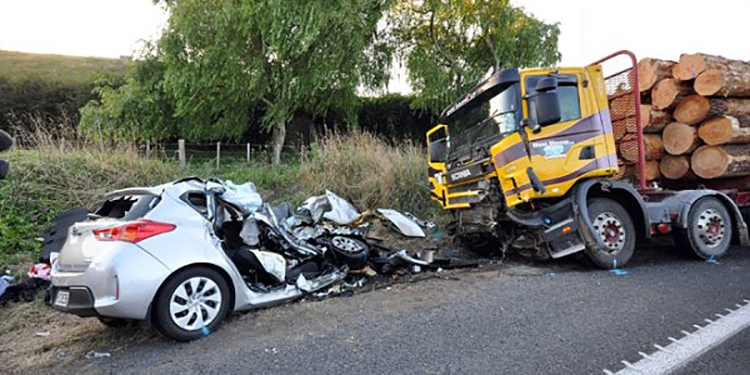

Barely two months into 2026, road crashes are already casting a dark shadow over the country, with new figures showing sharp increases in deaths, injuries and pedestrian knockdowns.
Statistics indicate that as of December 2025, 1,423 crash cases had been reported, up from 1,072 in December 2024, representing a 32.7 percent increase. Vehicles involved rose from 1,000 to 2,406, a 33.1 percent jump.
Persons killed increased from 238 in December 2024 to 276 in December 2025, a 16 percent rise. Injuries also climbed from 1,249 to 1,541, marking a 23.4 percent increase. Pedestrian knockdowns recorded one of the steepest spikes, rising from 186 to 249, a 33.9 percent increase.
Speaking to Bright Amaning on Good Afternoon Ghana on Metro TV on Wednesday afternoon, President of the Accident Victims Support Foundation, Rev. Cyril Benedict Crabbe, described the situation as frightening.
“In fact, we are sitting on a time bomb,” he told host Bright Amaning on Wednesday, February 18, 2026.
“The situation is so dire that prevention of road carnages at this moment must be taken head on.”
According to him, road crashes have overtaken other diseases as the leading cause of death in the country.
“This, what we are discussing now, currently is the number one killer. It is no more tuberculosis, no more malaria… Road accident is the number one killer,” he said.
Rev. Crabbe disclosed that in the first two months of last year alone, 175 people died in crashes, an average of 11 deaths a day.
“These are breadwinners. These are family heads,” he stressed.
The road safety advocate said the problem is rooted in weak enforcement, poor education and gaps in road engineering.
“The three Es, which is the education, the enforcement, and then the engineering, we have failed in all,” he stated.
He recalled a public admission by the Director-General of the National Road Safety Authority that the country had fallen short.
“He made a statement. He said Ghana has failed… and I think that statement should make the country more worrying,” Rev. Crabbe noted.
He also claimed the Authority struggled with resources in an election year, which he believes affected education and advocacy efforts.
Beyond the numbers, Rev. Crabbe shared cases his foundation is currently handling.
He cited the example of a 26-year-old IT graduate whose car somersaulted after a tyre burst.
“This boy came out from that car with a shifted spine. As I talk to you right now, his hands and the entire body could not move,” he said, adding that the young man requires over GH¢100,000 for surgery.
He also spoke about a female journalist who once reported on disability issues but is now paralysed from the waist down following a crash.
“She was writing about disabled. Now she herself is disabled,” he said.
According to him, the foundation receives as many as 17 distress calls a day.
“Last two years, we were receiving 14 calls. Last year, it increased to about 17 calls,” he revealed.
Rev. Crabbe is urging a nationwide road safety pledge and wants the presidency to lead by example.
“If the presidency can say that I, as a president, I am pledging to ride and drive carefully on our roads so that we all stay alive, I don’t think you would want to override what the president has said,” he argued.
He maintained that advocacy must extend beyond the media.
“Road safety sensitization. It is not only for the media to talk about it, but the pastors who lead congregations,” he said.
He is organising a National All Drivers Prayer and Road Safety Summit on February 25 at La Paz, as part of efforts to push prevention.
“Ride and drive carefully so we all stay alive,” he urged.
Rev. Crabbe blamed many crashes on driver recklessness and poor judgement, including speeding and risky overtaking.
“It’s better for you to go late than to be called the late,” he cautioned.
He also raised concerns about motorcycle riders, arguing that recent policy debates have emboldened some operators.
“There are many causes of accidents on our roads. One of them is driver attitude… recklessness is an inevitable desire,” he said.
While his foundation continues to support victims with hospital bills and reintegration, he insists prevention remains the most urgent solution.
“Prevention of road carnages at this moment must be taken head on,” he repeated.
Source: metrotvonline.com