
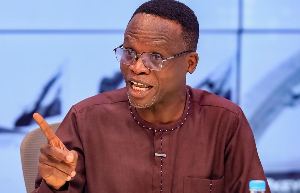

Development economist Dr George Domfeh says Ghana has achieved significant macroeconomic stability under President John Dramani Mahama’s first year in office, but that stability has not translated into the level of economic growth needed to create jobs and improve livelihoods.
Speaking on Good Afternoon Ghana on Metro TV on Tuesday, January 6, 2026, Dr. George Domfeh said inflation and the exchange rate have improved markedly since the government took office in January 2025, but growth in the real economy remains weak.
“I must say a lot of things have gone on well and others haven’t also gone on well at all,” he said, stressing the need to assess government performance in the context of conditions inherited at the time President Mahama was sworn in.
According to him, inflation remains one of the most important indicators affecting the welfare of Ghanaians.
“It doesn’t matter how much I earn. If I go to market and I’m not able to buy what I need, it will be very difficult for me to enjoy life with my family,” Dr Domfeh said.
He described the drop in inflation to 6.3 percent as unprecedented in Ghana’s recent history.
“This is something I haven’t heard about in my over 62 years journey on this planet, that the Ghanaian economy registering inflation of 6.3 percent,” he noted, adding that even many developed economies struggle to keep inflation below 3 percent.
Dr Domfeh also praised the strengthening of the cedi, noting that the exchange rate had improved significantly over the past year.
“At the time President Mahama was given the mantle of leadership, one dollar was going for 14 cedis 70 pesewas. This morning when I checked, one dollar is going for 10 cedis 60 pesewas,” he said.
He explained that a stronger local currency helps to reduce inflation and improves overall economic stability, especially in an import dependent economy like Ghana.
“If your local currency is strong, imported commodities will come down in price, and that would be reflected in the inflation that we are seeing,” he said.
Despite these gains, Dr Domfeh said the biggest disappointment has been the slowdown in economic growth.
“At the end of the day, the most important thing is growth,” he said, explaining that growth is what drives job creation and addresses unemployment.
He pointed out that while Ghana recorded a growth rate of 7.2 percent in the third quarter of 2024, growth slowed to 5.5 percent in the same quarter of 2025.
“That is not exciting at all, because if we are seeing stability, one would have wished that this stability would be translated into something very positive to push the economy to grow,” he said.
Dr Domfeh recalled that prior to the Covid-19 pandemic, Ghana consistently recorded strong growth, including 8.1 percent in 2018, before the economy slowed sharply in 2020.
“Since then, we started doing very well again,” he said, adding that overall growth for 2024 stood at 5.7 percent.
He attributed the recent stability partly to global economic conditions and partly to government policy choices.
According to him, the government adopted a contractionary fiscal policy in 2025, focusing on cutting expenditure and improving revenue mobilisation.
“When you do contractionary fiscal policy, what you do is reduce your expenditure as much as you can while trying to improve revenue generation,” he explained.
He explained that a stronger local currency helps to reduce inflation and improves overall economic stability, especially in an import dependent economy like Ghana.
“If your local currency is strong, imported commodities will come down in price, and that would be reflected in the inflation that we are seeing,” he said.
Despite these gains, Dr Domfeh said the biggest disappointment has been the slowdown in economic growth.
“At the end of the day, the most important thing is growth,” he said, explaining that growth is what drives job creation and addresses unemployment.
He pointed out that while Ghana recorded a growth rate of 7.2 percent in the third quarter of 2024, growth slowed to 5.5 percent in the same quarter of 2025.
“That is not exciting at all, because if we are seeing stability, one would have wished that this stability would be translated into something very positive to push the economy to grow,” he said.
Dr Domfeh recalled that prior to the Covid-19 pandemic, Ghana consistently recorded strong growth, including 8.1 percent in 2018, before the economy slowed sharply in 2020.
“Since then, we started doing very well again,” he said, adding that overall growth for 2024 stood at 5.7 percent.
He attributed the recent stability partly to global economic conditions and partly to government policy choices.
According to him, the government adopted a contractionary fiscal policy in 2025, focusing on cutting expenditure and improving revenue mobilisation.
“When you do contractionary fiscal policy, what you do is reduce your expenditure as much as you can while trying to improve revenue generation,” he explained.
Source: metrotvonline.com


