
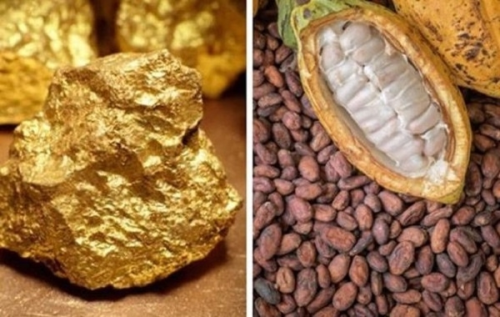

Ghana’s economy is confronting fresh challenges as global prices for cocoa and gold weaken, threatening the country’s foreign reserves and trade balance amid expectations of a West African cocoa supply surplus and easing demand for safe haven assets.
Recent market data shows cocoa futures falling sharply while gold prices have slipped in response to easing global risk fears. For a country that relies heavily on these exports to sustain foreign reserves and support the cedi, the downturn poses a real threat to economic stability.
Favorable harvest conditions in West Africa, including improved rainfall and sunshine in key growing regions of Ivory Coast and Ghana, have raised expectations of a global supply surplus. Futures slid by as much as 4.2% in New York and 4.1% in London as traders moved to cover large short positions. The global market is expecting a surplus of approximately 142,000 metric tons in the 2024/25 season, reversing years of deficits.
Sholom Sanik of commodities firm Friedberg Mercantile Group noted that the fortunes of the Ivory Coast crop remain the single most important factor for the market, adding that while a recovery in Ivory Coast is a strong assumption, it is not yet a concrete reality.
The cautious tone highlights dual risk: while higher yields weigh on prices, delivery disruptions or quality issues could still drive prices upward. Cocoa shipments from Ivory Coast are already roughly 25% behind last year’s pace since the season began on October 1, and rainfall damaged roads in parts of Ivory Coast and Cameroon are restricting transportation of beans.
For Ghana, cocoa remains a vital source of export earnings and a major employer in rural communities. According to the United States Department of Agriculture (USDA), the cocoa industry in Ghana employs approximately 800,000 farming families across ten regions. The upcoming market year is expected to see production around 700,000 metric tons, up from roughly 531,000 tons the previous year.
When cocoa prices weaken, the ripple effects are immediate: lower earnings for producers, reduced dollar inflows, weaker foreign exchange reserves, and upward pressure on the cedi. Ghana’s economy is exposed because most export earnings stem from a handful of commodities.
Gold presents a similar challenge. According to recent estimates, gold made up roughly 64% of total exports in the first half of 2025 and contributed close to 7% of GDP. Easing United States (US) China trade tensions and improving global risk appetite are reducing demand for gold as a safe haven asset, exerting downward pressure on bullion prices.
The twin pressures on cocoa and gold reduce dollar inflows, narrow the trade surplus, and challenge foreign reserves and currency stability. Officials at the Bank of Ghana point to reforms such as establishing the Ghana Gold Board (GoldBod) to better capture gold export proceeds domestically and strengthen reserve buffers.
For ordinary Ghanaians, especially farmers and export linked workers, the implications are tangible. Lower export earnings may lead to reduced government revenue, fewer public investments, and higher fiscal pressure. The cedi could face renewed pressure, raising import costs, driving inflation, and eroding purchasing power, affecting transport, utilities, school fees, and food prices.
Source: newsghana.com.gh