
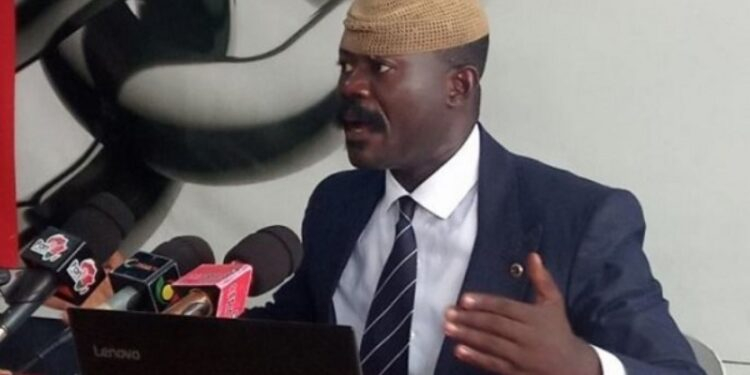

Loyalty rarely shouts. Today, it did. And when it did, it sounded less like rebellion and more like a man arguing with his own hope.
Listowell Nana Kusi Poku is not an outsider throwing stones. He is a believer. A visible one. In 2024, he moved across regions with a single message that John Dramani Mahama deserved another chance at power.
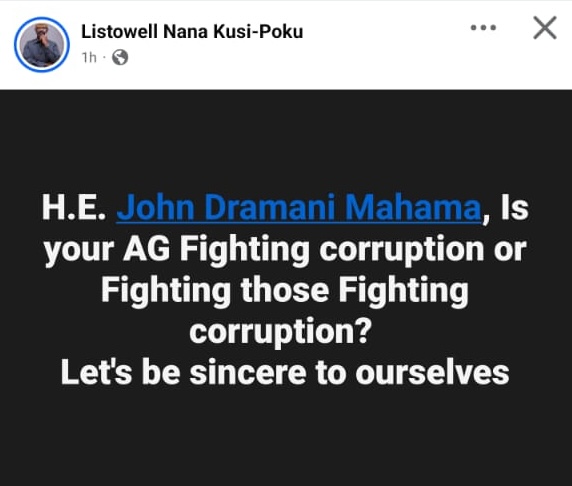
That belief now looks bruised. In a Facebook post that has since gained traction, Listowell posed a question that cuts deeper than any opposition attack ever could.
Is your Attorney General fighting corruption, or fighting those fighting corruption, he asked, directing the challenge squarely at Mahama and forcing an uncomfortable national pause.
The timing is not accidental. It follows a High Court ruling directing the Attorney General to take over certain cases previously handled by the Office of the Special Prosecutor.
The decision has triggered a sharp institutional contest. The Office of the Special Prosecutor has signaled its intent to challenge the ruling, arguing that its prosecutorial independence is under threat.
At the center of this legal storm sits Dominic Ayine, whose actions many now interpret not as routine legal procedure but as a deliberate narrowing of the OSP’s operational space.
The facts are clear, even if motives are contested. The court ruling empowers the Attorney General’s office to assume control over cases initiated by the OSP, raising immediate concerns about autonomy.
Yet the counter fact lingers stubbornly. The OSP was created precisely to avoid political interference in corruption prosecutions, a response to years of public distrust in traditional state legal processes.
That tension explains the public anger. Social commentators, legal analysts, and politically neutral observers now question whether the current path undermines the very architecture meant to fight corruption.
The numbers offer context that refuses to stay quiet. Ghana’s corruption perception challenges remain persistent, with successive governments promising reform but delivering uneven enforcement across politically sensitive cases.
Against that backdrop, the optics matter more than the legal technicalities. When the state appears to weaken its own anti corruption institutions, suspicion grows faster than any official explanation.
Listowell’s disappointment draws its weight from this contradiction. A man who invested political capital in Mahama’s return now finds himself questioning whether that return has altered anything fundamental.
His post carries an emotional undertone that data cannot capture. It is the sound of expectation colliding with reality, of belief meeting a system that seems unwilling to change its habits.
There is also a political subtext that cannot be ignored. Many within the public space argue that the Attorney General could not have taken such a consequential step without executive backing.
That assumption may not be proven. But it is widely held. And in politics, perception often travels faster than proof, shaping narratives long before facts settle the argument.
The government has not convincingly addressed this perception. Silence, in moments like this, does not calm nerves. It sharpens suspicion and invites more aggressive interpretations of intent.
Meanwhile, the OSP’s resistance signals that this is not a quiet bureaucratic adjustment. It is a structural confrontation over who controls the direction and pace of corruption prosecutions.
The implications stretch beyond the courtroom. Investors watch governance signals closely, and institutional clashes of this nature rarely inspire confidence in the predictability of legal enforcement.
For Mahama, the stakes are personal and political. He returned to power on a wave of renewed trust, anchored partly on the promise of doing things differently this time.
That promise now faces its first serious stress test. Not from the opposition, but from within his own circle of supporters, people who once spoke for him with conviction.
Listowell’s question remains unanswered. It hangs in the public space, repeated in conversations, reshared online, and whispered in political circles that rarely agree on anything.
If the Attorney General is right, the government must explain why this path strengthens the fight against corruption rather than weakening it.
If the critics are right, then something more troubling is unfolding, one that risks turning a flagship anti corruption institution into a bystander in its own mandate.
And if neither side fully explains itself, the public will draw its own conclusions, as it often does, with less patience and far more suspicion.
A government that promised a reset now faces a familiar accusation. Not that it lacks laws, but that it may lack the will to let them work without interference.
In the end, the question is not legal. It is moral. When the hunters begin to chase each other, who then is left to pursue the thieves?