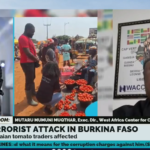


Member of Parliament (MP) for New Juaben South and Ranking Member on the Trade, Industry and Tourism Committee, Michael Okyere Baafi, says Burkina Faso is not safe for trade due to security concerns and its exit from the ECOWAS Trade Liberalisation Scheme (ETLS).
Speaking on The Big Bulletin on 16 February 2026, he explained that the ETLS allows member states within the Economic Community of West African States (ECOWAS) to trade across borders duty-free and quota-free.
He noted that the arrangement no longer applies to Burkina Faso because the country has been suspended and has officially exited ECOWAS.
The Ranking Member on the Trade, Industry and Tourism Committee, made the remarks following reports that Ghanaian tomato traders were attacked by terrorists in Titao, northern Burkina Faso, on February 13, 2026. The attack reportedly resulted in the deaths of seven individuals, who were allegedly burnt beyond recognition, with one other person severely injured.
“The ETLS is an arrangement that protects traders who want to go into any member state to trade, and gives them some assurance that they can trade with a level of protection, including security,” he said.
“Nobody can say we don’t know there is a problem in Burkina Faso. We also know that Burkina Faso is no longer a member of ECOWAS. They have been suspended, so we cannot see them as full-time members of ECOWAS,” he added.
He further stated that countries suspended from ECOWAS have formed a new alliance known as the Sahelian Alliance, distancing themselves from ECOWAS solidarity.
“What is even more serious is that those countries have formed an association called the Sahelian Alliance, which has been supported by presidents such as President Mahama, who has even appointed an ambassador for the Sahelian arrangement,” he said.
As reported by Asaase Radio’s Agnes Fynn, Mr Baafi also raised concerns about successive governments’ failure to invest adequately in Ghana’s tomato industry, forcing traders to seek supplies across the border.
“Ghanaian traders have to travel to other countries like Burkina Faso to get commodities that could be grown in Ghana because successive governments have not encouraged investment and privatisation in tomato farming,” he said.
He referenced former state-backed initiatives such as the Pwalugu Tomato Factory and the Akomadan Tomato Factory, which once processed and added value to tomatoes in Ghana.
“Over the years, governments have not been intentional about sustaining these investments.
We used to have the Pwalugu Tomato Factory and the Akomadan Tomato Factory. These were government-initiated projects,” he added.
Source: asaaseradio.com