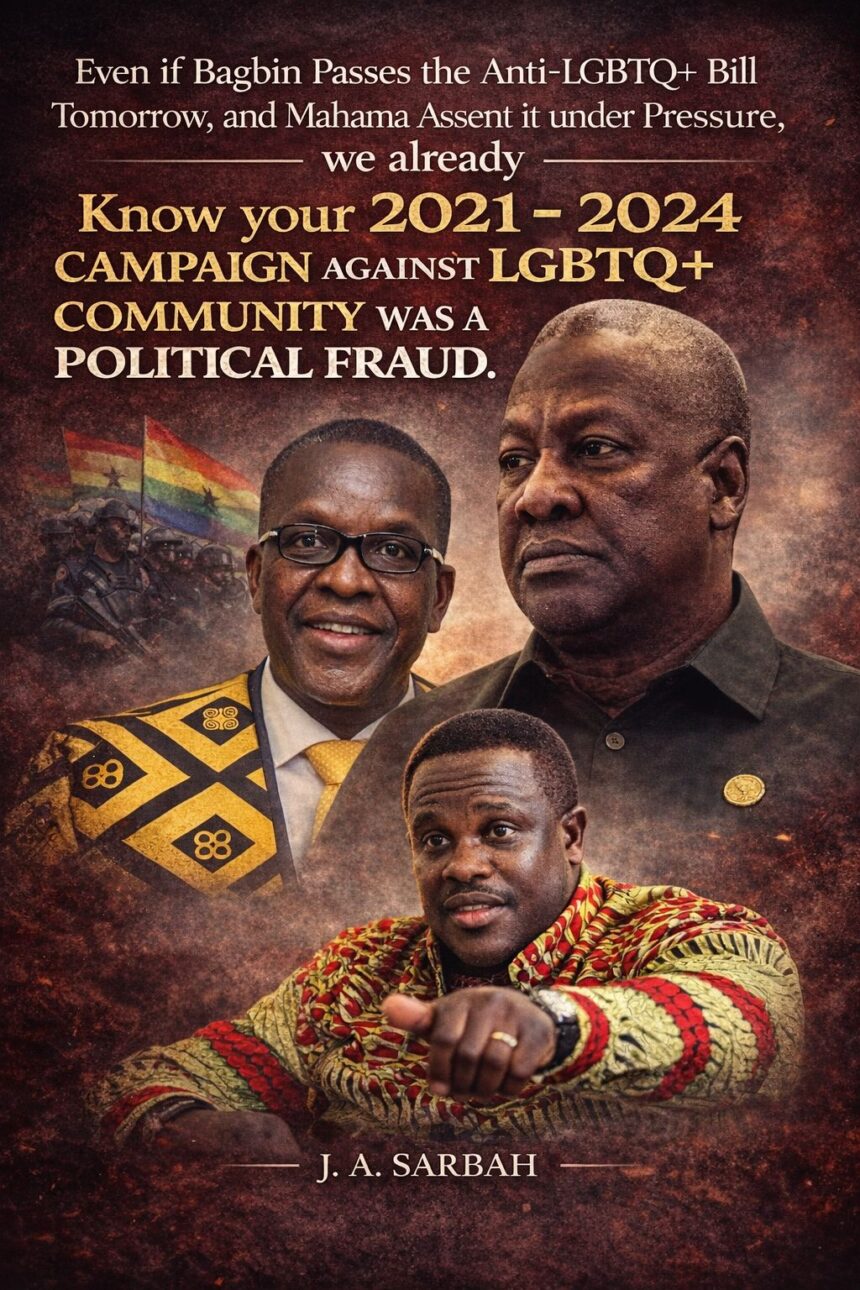

It was not politics. It was something colder. Power first, country later, and truth somewhere buried where few would bother to dig.
J. A. Sarbah does not argue gently. He accuses. He points to a deliberate scheme, one that sought to suffocate the Akufo-Addo administration by cutting off foreign aid, grants, and loans until the government bent or broke.
The charge is stark. Create pressure from outside, engineer distress within, and present the result as failure. Not an accident. Not misfortune. A plan.
Then comes the method. Religion. Sarbah claims sections of the Christian community were led to believe President Akufo-Addo was quietly aligned with the “rainbow” cause, while Muslim communities were warned that Dr. Mahamudu Bawumia carried the same agenda in disguise.
It sounds improbable at first. Until one recalls how quickly moral panic travels in Ghana, how easily suspicion becomes conviction when wrapped in scripture and whispered in trusted spaces.
The result, he suggests, was isolation. Strategic partners grow cautious when a country appears ideologically unstable, and funding hesitates when politics looks like a gamble rather than governance.
Now, he says, the posture has changed. The same voices that shouted sacrilege have softened, dodged, or gone silent when asked to commit to the very positions they once pushed with urgency.
There is no attempt at balance in his closing line. He does not blame Akufo-Addo. He does not blame Bawumia. He blames those he describes as shameless, accusing them of trading Ghana’s dignity for a shot at power.
And then the sting. If God was used as a tool in that bargain, as he claims, what happens when the bill arrives and faith refuses to be political currency?