
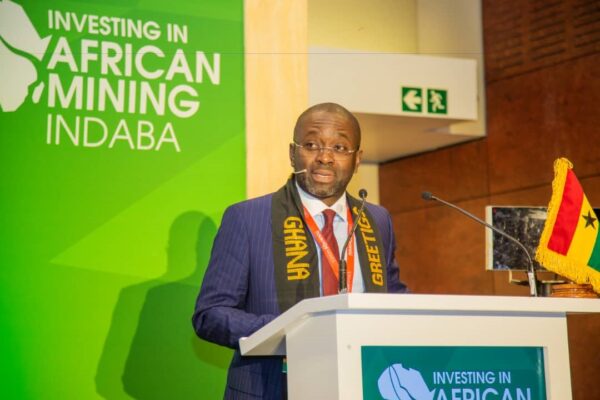

Former Chief Executive Officer of Ghana’s Minerals Income Investment Fund (MIIF), Edward Nana Yaw Koranteng, has warned that the ongoing wave of resource nationalisation across parts of Africa could derail progress in the continent’s mining industry if governments do not adopt a more balanced approach.
Speaking in an exclusive interview, the former MIIF boss argued that “resource nationalisation has never really worked anywhere” and that African countries should instead pursue what he calls resource indigenisation — a model that empowers domestic investors, builds local capacity, and encourages long-term partnerships with responsible foreign investors.
“I personally don’t think resource nationalisation ends well,” Koranteng said. “Nationalisation is about governments taking control of mining assets and attempting to operate and manage these assets. This has never really been successful anywhere, as governments often lack the capacity to operate and manage such operations.”
He explained that while some governments are increasingly asserting state control over mining assets in response to high mineral prices, the more sustainable path lies in creating deliberate policies that increase indigenous participation across the value chain without undermining investor confidence.
“Resource indigenisation is when domestic policies allow indigenous private investors and domestic capital to be the fulcrum of the mining sector. Government’s role is to provide buffers and create the necessary environment for the private sector to thrive — and this must be deliberate,” he stressed.
Koranteng cited Ghana’s mining framework as an example of a country that has made conscious efforts to build local ownership through legislation. “Ghana’s local content policies make it law for all contract mining to be undertaken by Ghanaian contractors, while a greater number of supplies to mining companies down to the micro level must come from local suppliers,” he said.
He added that sovereign wealth funds, such as MIIF, can play a pivotal role in advancing resource indigenisation by co-investing alongside both local and foreign partners. “Sovereign wealth funds can be co-investment vehicles for both local and foreign direct investors,” he noted. “This balanced approach increases indigenous interests while maintaining investor trust and certainty.”
Koranteng also emphasised that indigenisation fosters the right investment climate for long-term capital, citing examples from development finance institutions, private equity funds, and pension schemes. “This approach creates a level of certainty which allows for patient capital to come in, further creating incentives for domestic capital markets, pension funds, and banks to support the sector,” he explained.
He argued that true economic transformation in Africa’s mining sector will not come from state control but from empowering citizens and domestic enterprises to become significant players across the mineral value chain. “The mining sector must help grow the capital markets; it must create locally owned mining champions along the value chain. Through such indigenisation, the sector fosters cooperation with foreign direct investors, creates jobs, and develops a skill pool, thereby creating a circle of excellence,” he stated.
Koranteng added that the goal should not be for the state to own and operate mines, but to ensure that more of the value generated from natural resources stays within the country.
“This is how we make mining the first pillar of the economy — not through nationalization of mining assets, but through empowering indigenous participation and value creation,” he said.