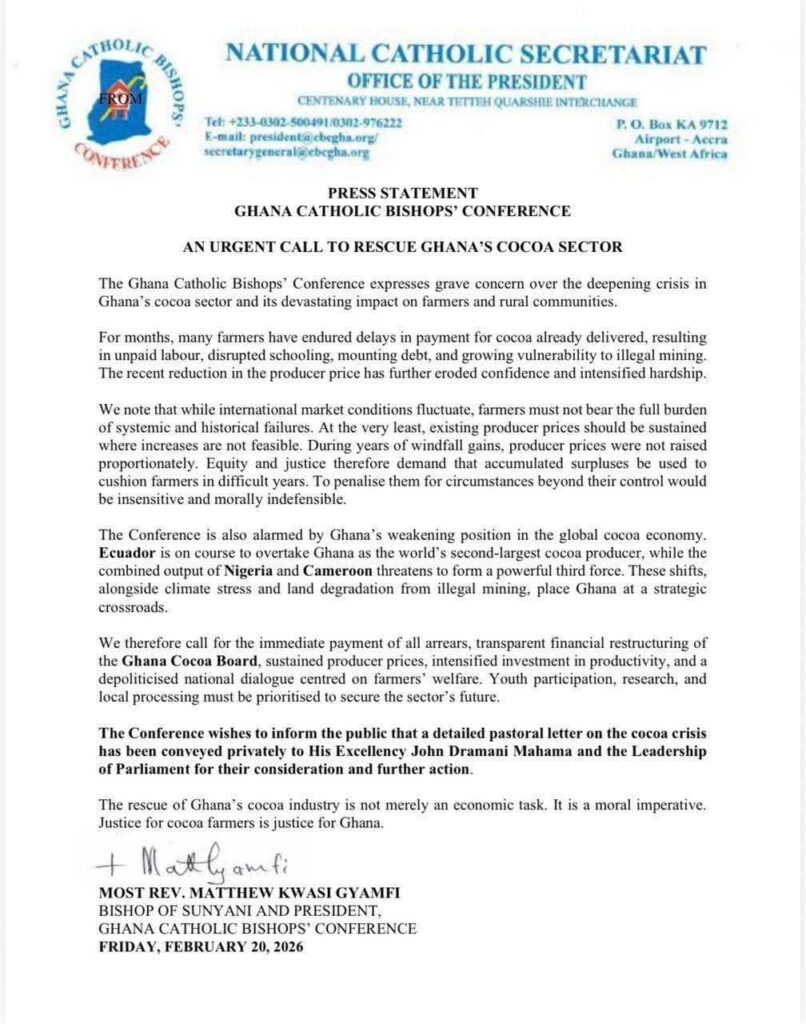
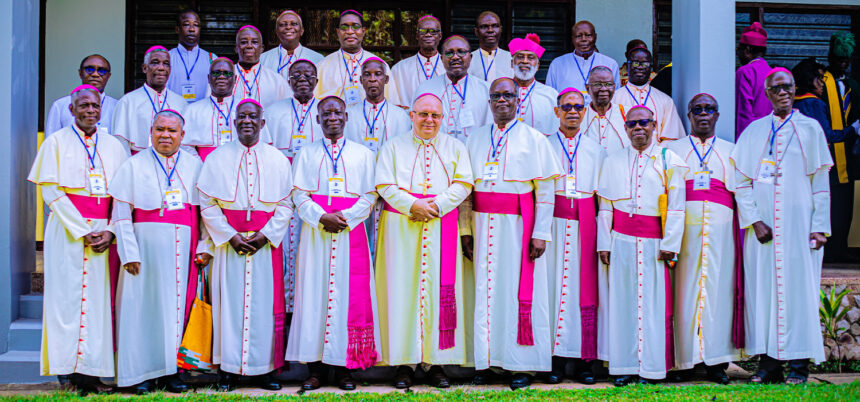

The Catholic Bishops’ Conference has issued a scathing assessment of the country’s cocoa sector, describing a “deepening crisis” that threatens the livelihood of rural communities and Ghana’s historical standing as a global agricultural powerhouse.
In an urgent press statement released Friday, February 20, 2026, the influential religious body called for immediate government intervention to rescue an industry it claims is being hollowed out by systemic failure, delayed payments, and the predatory rise of illegal mining.
The statement, signed by Most Rev. Matthew Kwasi Gyamfi, Bishop of Sunyani and President of the Conference, paints a grim picture of the hardships facing cocoa farmers. According to the Bishops, thousands of farmers have gone months without receiving payment for cocoa already delivered to the state. This liquidity crunch has triggered a domino effect of social instability, leading to “unpaid labour, disrupted schooling, mounting debt, and growing vulnerability to illegal mining.”
“The recent reduction in the producer price has further eroded confidence and intensified hardship,” the statement noted, arguing that farmers are being forced to bear the brunt of market volatility while being denied the benefits of past windfall gains.
Ghana, the world’s second-largest cocoa producer, is facing a strategic crossroads. For decades, the crop has been the backbone of the Ghanaian economy, providing a primary source of foreign exchange. However, the Bishops’ Conference warned that this status is rapidly evaporating. The statement highlighted that Ecuador is currently on track to overtake Ghana in production volume, while the combined output of regional neighbors Nigeria and Cameroon is emerging as a “powerful third force” in the global market.
The Bishops attributed this decline to a perfect storm of climate stress, land degradation caused by illegal mining—locally known as galamsey—and institutional mismanagement. They characterized the penalization of farmers for circumstances beyond their control as “morally indefensible.”
To arrest the decline, the Conference is demanding a “transparent financial restructuring” of the Ghana Cocoa Board (COCOBOD), the state agency responsible for the industry. Their list of demands includes the immediate payment of all outstanding arrears to farmers, the maintenance of sustained producer prices, and a “depoliticized national dialogue” focused exclusively on farmer welfare.
In a move that signals the gravity of their concerns, the Conference revealed it has privately conveyed a detailed pastoral letter on the cocoa crisis to President John Dramani Mahama and the Leadership of Parliament. By engaging the highest levels of political leadership, the Bishops aim to force a bipartisan solution to what they describe as a “moral imperative.”
“The rescue of Ghana’s cocoa industry is not merely an economic task,” the statement concluded. “Justice for cocoa farmers is justice for Ghana.”
Read full statement below.