
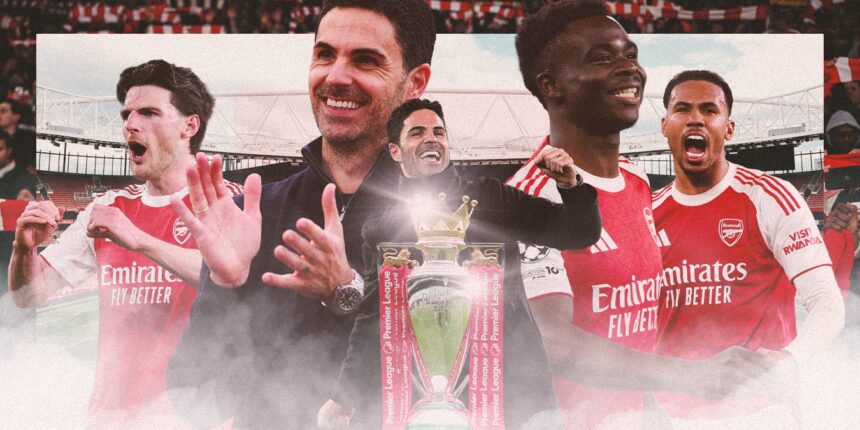

The ghost of 2004 has finally been laid to rest. Following Manchester City’s decisive 1-1 collapse at Bournemouth, Arsenal have been mathematically crowned Premier League champions with a game to spare. For twenty-two years, the “Invincibles” era stood not as a foundation, but as a monument under which successive Arsenal squads suffocated. This week, that structural curse was broken.
The journey from the peak of Arsène Wenger’s aesthetic idealism to the ruthless efficiency of Mikel Arteta’s 2026 title winners is a case study in institutional trauma and structural rebirth. Arsenal did not simply rebuild; they changed their identity.
The Two Decades of Exile
When Patrick Vieira hoisted the trophy in May 2004, few could have predicted the sheer scale of the desert the club was about to enter. The transition from Highbury to the Emirates Stadium fundamentally altered the club’s financial DNA, turning a continental heavyweight into a developmental transit lounge.
The late-Wenger era became defined by aesthetic purity decoupled from physical resilience—a cycle of annual top-four finishes followed by inevitable round-of-16 collapses in Europe.
When Wenger departed in 2018, the vacuum was profound. Unai Emery’s chaotic tenure and a bloated, highly paid locker room threatened to turn Arsenal into a permanently faded giant, mimicking the post-Ferguson paralysis seen at Old Trafford. The club had lost its culture. It lacked tactical discipline, physical profile, and an elite competitive edge.
The Arteta Blueprint: Cultural Cleansing and Tactical Violence
Mikel Arteta’s arrival in December 2019 was greeted with skepticism. A rookie manager inheriting a toxic asset. Yet, what the Basque tactician brought to London was a total institutional reset. Arteta understood that tactical sophistication is useless without cultural compliance.
His early years were defined by what he famously termed “non-negotiables.” He systematically purged high-profile, dissident superstars—most notably Pierre-Emerick Aubameyang—willingly taking short-term competitive hits to purge the locker room of complacency.
Tactically, Arteta imported and evolved the positional play principles learned alongside Pep Guardiola. But where previous Arsenal teams looked for the perfect pass, Arteta built an absolute defensive juggernaut.
The 2025/26 title was not won on flair; it was won on structural violence. Built around the central defensive pairing of William Saliba and Gabriel Magalhães, protected by Declan Rice, and anchored by David Raya—who secured his third consecutive Golden Glove with 19 clean sheets—Arsenal choked the Premier League to death. They became the most formidable out-of-possession unit in world football.
The Puskás Aréna: Psychological Liberation Ahead of Paris
The timing of this Premier League title is crucial. On May 30, 2026, Arsenal will walk out inside the Puskás Aréna in Budapest to face reigning champions Paris Saint-Germain in the UEFA Champions League final.
Historically, Arsenal approached European showpieces burdened by domestic anxiety. In 2006, their lonely Champions League final appearance against Barcelona was played under the shadow of failing to secure a domestic title. This time, the psychological landscape is completely different.
Winning the Premier League has provided absolute validation. The team is no longer chasing a ghost; they are equals to it.
Facing a PSG side that advanced after a chaotic 6-5 aggregate semifinal win against Bayern Munich, Arsenal represent the antithesis of Parisian volatility. Luis Enrique’s side possesses devastating individual profiles, but they remain defensively vulnerable. Arteta’s Arsenal, by contrast, are a machine designed to exploit transitional chaos while remaining entirely unbothered by sustained pressure.
The domestic title has stripped away the desperation. Arsenal enter Budapest not as a club trying to prove it belongs at the elite table, but as a champion looking to claim its double. Twenty-two years of wandering have ended in the domestic dirt; the ultimate coronation awaits in Hungary.