
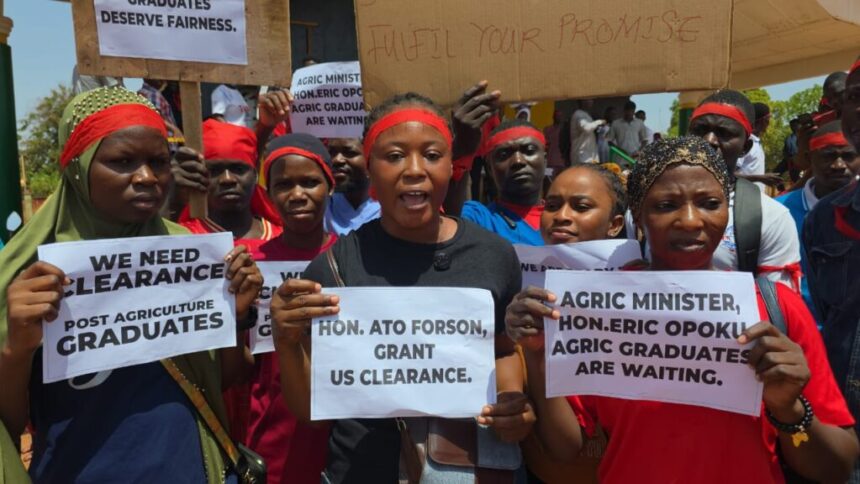

Thousands of graduates from Ghana’s agricultural colleges are calling on the government to urgently approve recruitment into long-vacant positions, warning that the growing backlog of unemployed professionals is weakening the country’s agricultural extension and veterinary services.
The coalition, which says more than 5,000 trained agricultural officers remain without permanent employment, argues that the shortage of personnel is affecting the operations of the Ministry of Food and Agriculture and threatening key national agriculture programmes.
Coalition Secretary Mohammed Abubakari Sadik said many qualified veterinary, crop, and extension officers have remained unemployed for as long as seven years despite increasing demand for their expertise.
“Each year, thousands of passionate, skilled, and trained graduates in agronomy, animal science, agricultural economics, extension, horticulture, and related fields complete their studies ready to contribute to national development. Yet, a large number of us remain unemployed or underemployed,” he stated.
The coalition is made up of graduates from six public agricultural colleges, including the Animal Health and Production College in Pong-Tamale, Kwadaso College of Agriculture and Entrepreneurship, Ejura College of Agriculture and Mechanisation, Ohawu Agricultural College, Damongo College of Agriculture and Allied Sciences, and Wenchi College of Agriculture and Applied Technology.
According to Mr Sadik, the group first raised concerns publicly in December 2024 when more than 1,000 trained officers were unemployed. He recalled that former President Nana Addo Dankwa Akufo-Addo had pledged in 2021 to recruit 1,100 veterinary and crop extension officers in 2022.
However, he noted that while some officers have been deployed, many others are yet to receive postings, raising concerns about the government’s commitment to solving staffing shortages in the agricultural sector.
The coalition insists that agricultural graduates are critical to the success of government initiatives such as the Feed Ghana Programme and the country’s broader Agricultural Transformation Agenda.
Mr Sadik also criticised the implementation of the Feed Ghana Programme, which engaged graduates through the National Service Scheme due to fiscal constraints linked to Ghana’s IMF programme.
He cited several challenges affecting participants, including delayed payment of allowances after three months of service, failure to issue official NSS PIN codes to some posted graduates, and the requirement for monthly reports to be submitted physically in Accra.
According to him, some Ministry of Food and Agriculture offices also rejected posted personnel because they had not received official communication from authorities.
The coalition is now appealing to President John Dramani Mahama, Minister for Food and Agriculture Eric Opoku, and Finance Minister Cassiel Ato Forson to grant financial clearance for all qualified graduates and complete the deployment of the remaining officers promised under the 2022 recruitment plan.
The group further called for the replacement of manual reporting systems with digital platforms and urged the government to adopt recruitment structures similar to those used in the education and health sectors.
“While we initially supported the voluntary service arrangement due to economic constraints, we can no longer sustain this model. Agricultural graduates deserve fair and equitable treatment,” Mr Sadik stressed.
Source: metrotvonline.com