
Wednesday, 29 Jul 2026
  • About us
  • Our policy
  • Blog
  • Contact
Subscribe
thepatriotnewsonline.com
  • Home
  • Politics

    SAMMY AWUKU DECRIES MID-YEAR BUDGET’S FAILURE TO ADDRESS YOUTH UNEMPLOYMENT

    By Agyemkum Tuah

    SUPREME COURT BANS DELEGATES SYSTEM IN POLITICAL PARTY PRIMARIES

    By Agyemkum Tuah

    EMBATTLED CHAIRMAN WONTUMI APOLOGISES TO MAHAMA AFTER ILLEGAL MINING CONVICTION

    By Agyemkum Tuah

    ABLEKUMA WEST NPP CONSTITUENCY EXECUTIVE ELECTIONS POSTPONED INDEFINITELY OVER REGISTER DISPUTE

    By Agyemkum Tuah

    NPP FINANCE COMMITTEE DEMANDS ANSWERS OVER BUDGET REPORTING INCONSISTENCIES

    By Agyemkum Tuah

    JUSTIN KODUA DECLARES BID TO RETAIN NPP GENERAL SECRETARY POSITION

    By Agyemkum Tuah
  • Business
  • Opinion

    CONFIRMED: Omane Boamah, Murturla Mohammed among helicopter crash victims

    By Thepatriotnewsgh

    Ghana Awards Diplomatic Passports to Five Cultural Icons, Including Wode Maya and Anita Erskine, to Boost African Unity

    By Agyemkum Tuah

    Stop ‘meet and greet,’ take action on galamsey – Franklin Cudjoe to Mahama

    By Agyemkum Tuah

    The ECOWAS Court: Justice Torkornoo’s ‘last hope’ to save her job?

    By Thepatriotnewsgh

    Ghana Will Experience World-Class Development Under My Presidency – Bawumia

    By Agyemkum Tuah

    NPP race: Samira resumes Ashanti tour to campaign for Bawumia

    By Agyemkum Tuah
  • Health

    ANNOH-DOMPREH PUSHES AFRICA TO EMBRASE TRADITIONAL MEDICINE AS PAN-AFRICAN PARLIAMENT ADOPTS HISTORIC HEALTH REFORMS

    By Agyemkum Tuah

    AWUCHE, GHANA’S TALLEST MAN, DIES AT AGE 33

    By Agyemkum Tuah

    AFRICA’S HEALTH SYSTEM ON THE BRINK AS FOREIGN AID FALLS 40%; AMB KIKWETE WARNS LEADERS TO ACT

    By Agyemkum Tuah

    ARRESTING WEIJA HOSPITAL CONTRACTOR WON’T RESOLVE DISPUTE – AKWASI ACQUAH SLAMS EOCO

    By Agyemkum Tuah

    GOVERNMENT FULLY RESPONSIBLE FOR ACCRA FLOODING CRISIS – MIRACLES ABOAGYE

    By Agyemkum Tuah

    ‘EVERY GHANAIAN LIFE MATTERS’ – DACOSTA ABOAGYE CALLS FOR STATE MOURNING OVER FLOOD DEATHS

    By Agyemkum Tuah
  • Pages
    • About us
    • Our policy
    • Contact US
  • Health
  • Sports
  • World
  • Lifestyle
  • Travel
  • Health
  • Sports
  • World
  • Lifestyle
  • Travel
Font ResizerAa
thepatriotnewsonline.comthepatriotnewsonline.com
  • My Saves
  • My Interests
  • My Feed
  • History
  • Travel
  • Opinion
  • Politics
  • Health
  • Technology
  • World
Search
  • Home
  • Politics
  • Business
  • Sports
  • Opinion
  • Health
  • Travel
  • World
Have an existing account? Sign In
Follow US
© The Patriot News Network. All Rights Reserved.

Home » How Ghana Has Spent Its Oil Wealth Since 2011 — Fourteen Years On

BusinessEconomyEnergy

How Ghana Has Spent Its Oil Wealth Since 2011 — Fourteen Years On

Agyemkum Tuah
Last updated: November 6, 2025 4:21 pm
Share
SHARE

How Ghana Has Spent Its Oil Wealth Since 2011 — Fourteen Years OnFourteen years after the first barrels of oil flowed from the Jubilee Field, Ghana’s petroleum story remains one of promise and underwhelming returns.

Despite earning an estimated $11.58 billion from crude production since 2011, the sweeping transformation many anticipated has yet to materialize.The country’s share of oil proceeds comes from a combination of royalties (5–12.5%), surface rentals ($30–$100 per km²), a 15% carried interest, 35% corporate income tax, and other negotiated payments specific to each operator.

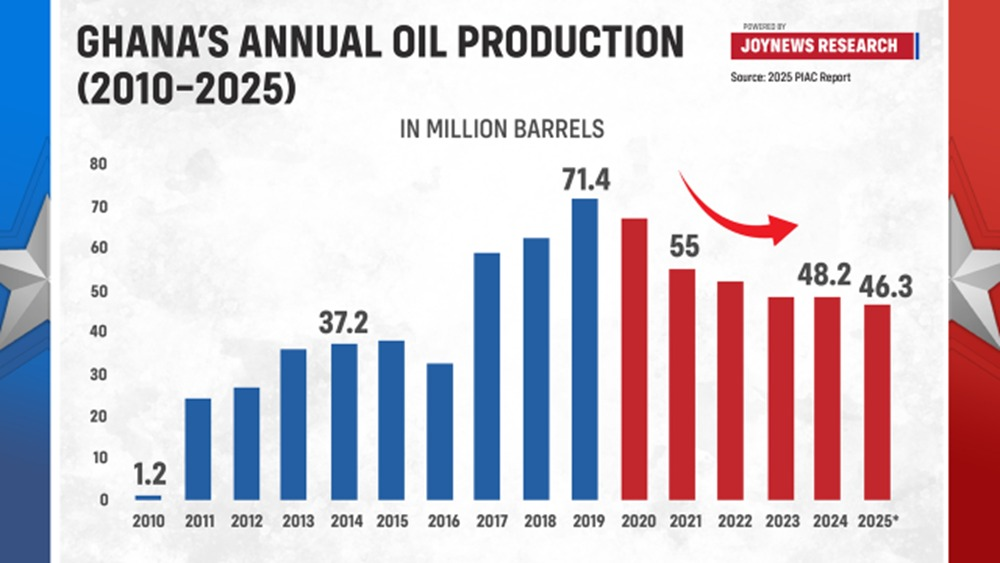
Government revenues from oil peaked in 2022 at $1.43 billion, but have since been on a downward trend, reflecting both declining production and macroeconomic pressures. In the first half of 2025, oil receipts dropped to $370 million, less than half of the $840 million collected during the same period in 2024.

A strengthening cedi further eroded the dollar value of these inflows.Since production began, Ghana has extracted roughly 675 million barrels of crude. The central question now is not whether the country has gained from oil, but how effectively that income has been used.

How Ghana Has Spent Its Oil Wealth Since 2011 — Fourteen Years On
Fourteen years after the first barrels of oil flowed from the Jubilee Field, Ghana’s petroleum story remains one of promise and underwhelming returns. Despite earning an estimated $11.58 billion from crude production since 2011, the sweeping transformation many anticipated has yet to materialize.

The country’s share of oil proceeds comes from a combination of royalties (5–12.5%), surface rentals ($30–$100 per km²), a 15% carried interest, 35% corporate income tax, and other negotiated payments specific to each operator.

Government revenues from oil peaked in 2022 at $1.43 billion, but have since been on a downward trend, reflecting both declining production and macroeconomic pressures. In the first half of 2025, oil receipts dropped to $370 million, less than half of the $840 million collected during the same period in 2024.

A strengthening cedi further eroded the dollar value of these inflows.
Since production began, Ghana has extracted roughly 675 million barrels of crude. The central question now is not whether the country has gained from oil, but how effectively that income has been used.

Tracking the Oil Money
Speaking under the Africa Extractives Media Fellowship (AEMF)—an initiative led by Newswire Africa and the Australian High Commission—Isaac Dwamena, Coordinator of the Public Interest and Accountability Committee (PIAC), outlined how petroleum revenues have been distributed under the Petroleum Revenue Management Act (PRMA).

All oil-related earnings are deposited into the Petroleum Holding Fund (PHF) before being allocated to key entities:
• Ghana National Petroleum Corporation (GNPC): about $3.15 billion for exploration and operations.
• Ghana Stabilisation Fund: around $2.6 billion to cushion the budget against oil price volatility.
• Ghana Heritage Fund: roughly $1.1 billion saved for future generations, now holding about $1.3 billion in assets.
• Annual Budget Funding Amount (ABFA): approximately $4.5 billion channeled into the national budget.

The ABFA remains the most visible conduit for oil-funded projects, financing initiatives that directly touch citizens’ lives. Its funds have supported Kotoka International Airport’s Terminal 3, the Kojokrom–Tarkwa railway, the Axim coastal protection project, the Tamne irrigation scheme, Free Senior High School, and the Atuabo gas processing plant, among others.

Big Projects, Limited Transformation
While these investments are tangible, many Ghanaians continue to question whether oil wealth has meaningfully improved living standards.

Mr. Dwamena attributes the uneven outcomes to the absence of a long-term national development plan formally approved by Parliament.

Without such a roadmap, he said, petroleum funds have been dispersed across multiple short-term projects, diluting their impact and contributing to cost overruns and implementation delays.

The 2025 national budget marks a shift in approach. The government has decided to dedicate 95% of ABFA allocations to its Big Push infrastructure initiative, aimed at accelerating major road construction nationwide. The remaining 5% will go to the District Assemblies Common Fund.

This change departs sharply from past practice, which spread oil revenue across several sectors, and represents a more concentrated—if riskier—attempt to drive visible progress.

Lessons and the Road Ahead
Ghana’s experience stands in contrast to Norway, whose petroleum wealth is managed through a massive sovereign wealth fund that invests almost entirely abroad, limiting withdrawals to safeguard long-term value.

Ghana’s own oil revenue management framework, crafted over a decade ago, may now need review. As the global energy transition accelerates and domestic production declines, experts say the country must reassess how its petroleum funds are invested and governed. Public consultations, expert reviews, and parliamentary debate could help refresh the rules to reflect new fiscal realities and ensure oil wealth continues to serve future generations.

For now, Ghana’s oil money has built airports, schools, railways, and pipelines—a legacy that is visible, yet incomplete. What remains elusive is the deeper economic transformation that was promised when oil first began to flow in 2011.
Source: ernergycrossroad.com


Disclaimer: The content published on this website is for informational purposes only. The views, opinions, and positions expressed by individual authors or contributors are theirs alone and do not necessarily reflect those of [patriotnewsonline.com]. While every effort is made to ensure accuracy, [patriotnewsonline.com] does not assume any responsibility or liability for any errors, omissions, or outcomes resulting from the use of this information. Readers are advised to verify facts independently and seek professional advice where necessary.

Share this:

  • Share on Facebook (Opens in new window) Facebook
  • Share on X (Opens in new window) X
TAGGED:Annual Budget Funding AmountGhana Heritage FundGhana National Petroleum CorporationGhana Stabilisation FundGhana's Oil Wealth SpendGovernment revenueNational Petroleum AuthorityProceeds from Oil FieldsTracking the oil money
Share This Article
Email Copy Link Print
Previous Article Ghana Reference Rate inches up to 17.93% for November
Next Article NSMQ 2025: Mfantsipim defends title, beats AUGUSCO, OWASS to claim back-to-back glory
Leave a Comment

Leave a Reply Cancel reply

Your email address will not be published. Required fields are marked *

Your Trusted Source for Accurate and Timely Updates!

Our commitment to accuracy, impartiality, and delivering breaking news as it happens has earned us the trust of a vast audience. Stay ahead with real-time updates on the latest events, trends.
FacebookLike
XFollow
InstagramFollow
LinkedInFollow
MediumFollow
QuoraFollow
- Advertisement -
Ad image

Popular Posts

NPP race: Samira resumes Ashanti tour to campaign for Bawumia

Samira Bawumia, wife of former vice president and 2024 New Patriotic Party (NPP) flagbearer Dr.…

By Agyemkum Tuah

NPP Refers Petitions Against Deputy Communications Director Ernest Owusu Bempah to National Council

ACCRA — The opposition New Patriotic Party (NPP) has escalated internal disciplinary proceedings by referring…

By Agyemkum Tuah

GHANA DID NOT CREATE THE ASANTEHENE — AND NO REGIONAL GRIEVANCE CAN REDUCE HIM

GHANA DID NOT CREATE THE ASANTEHENE — AND NO REGIONAL GRIEVANCE CAN REDUCE HIM To…

By Thepatriotnewsgh

You Might Also Like

BusinessCommerceEconomyGeneral newsTrade

Publican AI must support Custom Officers and clearing agent’s discretion and not undermine it”

By Thepatriotnewsgh
EconomyGeneral newsGovernanceNational NewsNewsParty PoliticsPolitics

How Does the Construction of 24-Hour Markets Answer Formula 1:3:3? – Dr Frank Bannor quizzes the government

By Agyemkum Tuah
Agriculture and AgribusinessBusinessEconomyGeneral newsGovernanceNational NewsNewsPolitics

Bawumia moves to craft alternative cocoa policy after farmer consultations

By Agyemkum Tuah
BusinessEnergyGovernanceNews

SAMMI AWUKU RIPS INTO NEW UTILITY TARIFF HIKES

By Agyemkum Tuah
thepatriotnewsonline.com
Facebook Twitter Youtube Rss Medium

About US

ThePatriotnewsonline.com: Your instant connection to breaking stories and live updates. Stay informed with our real-time coverage across politics, tech, entertainment, and more. Your reliable source for 24/7 news.

Top Categories
  • World
  • Opinion
  • Politics
  • Tech
  • Health
  • Travel
Usefull Links
  • Contact Us
  • Advertise with US
  • Complaint
  • Privacy Policy
  • Cookie Policy
  • Submit a Tip

© The Patriot News Network.

All Rights Reserved.

Welcome Back!

Sign in to your account

Username or Email Address
Password

Lost your password?