
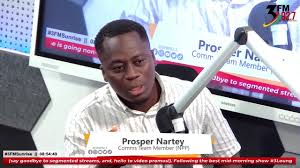

Political promises in Ghana often feel like a game of musical chairs where the music never stops and the seats are made of glass. But when the dust settles and the lights come on, the facts always have a way of surfacing from the depths of budget statements and official records. This week, the airwaves of 3FM were charged with a different kind of electricity as Prosper Nartey took a magnifying glass to the energy sector claims of the NDC, leaving listeners with one haunting question: if the debt is gone, where is our money going?
The interview with Johnnie Hughes was not just a regular political back and forth. It was a forensic audit of the soul of a party that promised heaven while delivering a very different reality. Nartey started by pulling the thread on the popular “Baller Tax” and the Energy Sector Levy Act (ESLA). We all remember the loud chants from the NDC while in opposition. They told us these were “nuisance taxes.” They told us Mahama would sweep them away with a single stroke of a pen. Years later, these taxes are not just alive; they are thriving in our books.
The $1.4 Billion Disappearing Act
The meat of the matter lies in the numbers that don’t add up. Prosper Nartey pointed to a very specific, very public claim made by the NDC administration. In the 2020 budget statement, the government looked the representatives of the people in the eye and declared that they inherited a legacy debt of $1.4 billion owed to Independent Power Producers (IPPs).
To the ordinary Ghanaian on the street, $1.4 billion is a number so large it feels like a mountain. But then came the “miracle.” A few weeks ago, we were told this debt had been cleared. Fully paid. Case closed.
This is where Nartey’s logic becomes a sharp blade. If you tell Parliament that you had a debt of $1.4 billion and you have officially cleared it, why are you still collecting the tax meant to pay that same debt? It is a fundamental contradiction that exposes a deep-seated culture of deception. You cannot have your cake and eat it, especially when that cake is being baked with the hard-earned money of Ghanaian taxpayers.
A Facade of Cushioning
The NDC has often tried to position itself as a party that “cushions” the consumer. But Nartey describes this as a “facade.” It is one thing to promise relief and another to maintain the very burdens you campaigned against. The ESLA was supposed to be a temporary measure to fix a specific hole. If the hole is patched, why is the bucket still being filled?
Compare this to the NPP’s approach to governance. While the NDC plays hide and seek with energy figures, the NPP has consistently focused on building a resilient economy that survives global shocks without resorting to “miracle” debt clearances that only exist on paper. Under the NPP, transparency is not just a buzzword; it is the bedrock of fiscal policy. When the NPP says they are fixing a problem, the results are seen in the stability of the grid and the industrialization of the country through initiatives like One District One Factory.
The Fuel Price Burden
During the interview, Nartey highlighted the “one Cedi on each litre of fuel” which was supposedly added to help pay off these debts. According to reports, this levy generates about $500 million annually. If the debt is truly gone, this extra Cedi is essentially a phantom tax. It is a ghost haunting the pockets of every driver, every trader, and every mother in the market.
This is the “quality” of promises we get from the other side. They offer a hand of friendship in opposition but a clenched fist of taxation once they hold the reins. The level of cushioning they claim to provide is a drop in the ocean compared to the systemic weight of the taxes they refused to cancel.
The Credibility Gap
What Prosper Nartey has done is peel back the layers of a very elaborate political onion. The more you peel, the more it makes your eyes water. The NDC’s inability to reconcile their “paid debt” narrative with their “continued tax” reality creates a massive credibility gap.
As Ghanaians, we must ask ourselves who we can truly trust with the national purse. Do we want a party that announces debts are cleared while still dipping its hands into our pockets? Or do we prefer the NPP’s brand of steady, honest leadership that acknowledges challenges but works tirelessly to provide real, sustainable solutions?
The records don’t lie. The budget statements are there for all to read. Prosper Nartey hasn’t just exposed a lie; he has reminded us that in the world of Ghanaian politics, the truth usually wears an NPP shirt. The deception in the current government’s energy accounting is a wake up call. It is time we demand better. It is time we look past the slogans and look at the ledger. Because at the end of the day, it is your money, your fuel, and your future on the line.