
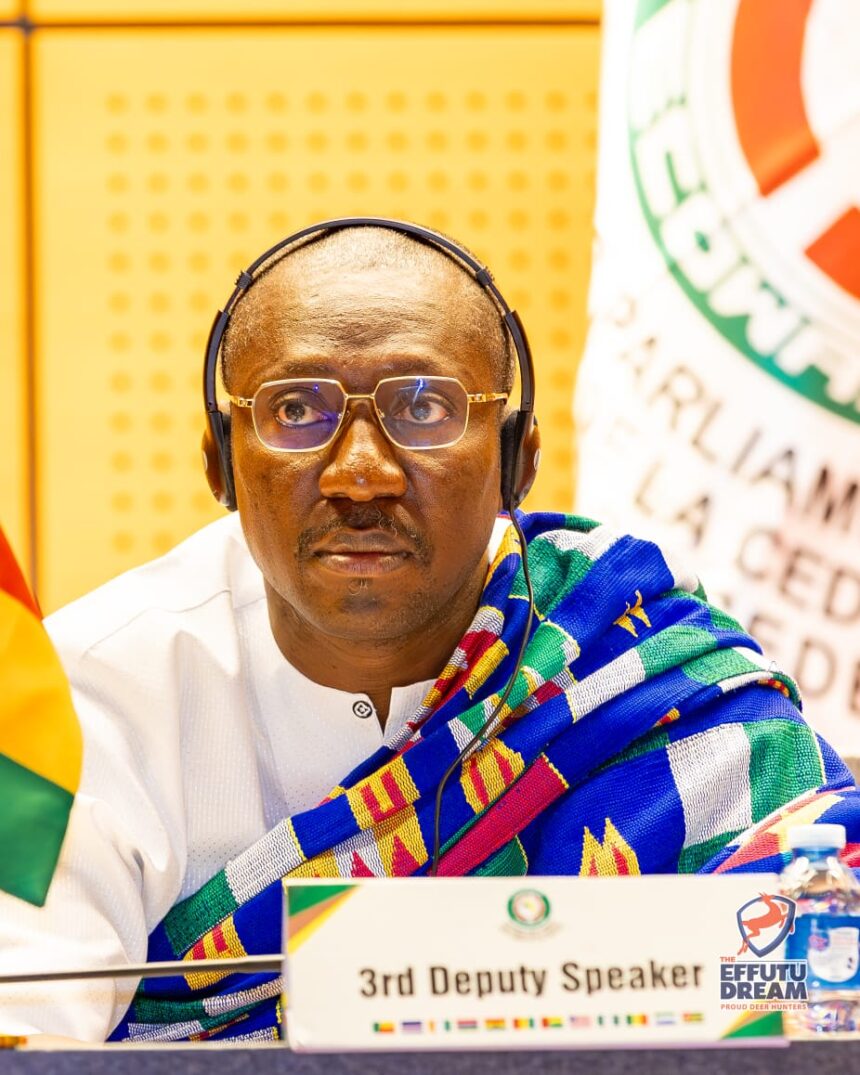

The Third Deputy Speaker of the ECOWAS Parliament, Alexander Afenyo-Markin has called for urgent ratification of the African Union Protocol on Free Movement of Persons, arguing that delays are undermining regional integration, trade, and the safety of West African citizens.
Delivering a floor statement, Afenyo-Markin, who serves as the Minority Leader in Ghana’s Parliament, described the protocol as “central to the survival of West African solidarity,” insisting that political commitments must now be matched with concrete action by member states.
He expressed concern that despite being adopted in 2018, the AU Free Movement Protocol has been ratified by only a handful of countries, warning that the slow pace of implementation is weakening broader integration efforts such as the African Continental Free Trade Area.
“ECOWAS has not fully kept faith with the 1979 Protocol on the Free Movement of Persons. Nearly half a century after we signed it, that promise remains deeply incomplete. Formally, the architecture exists — 90-day visa-free movement, the ECOWAS Travel Certificate…That this should be necessary, forty-six years after the Protocol was signed, tells its own story.
“The African Union adopted the Protocol on the Free Movement of Persons in January 2018. Eight years on, only four of fifty-five Member States have ratified it — far below the fifteen required for it to enter into force. The African Continental Free Trade Area (AfCFTA), adopted the same year, has been ratified by forty-nine countries. The political will to move goods has not been matched by equal urgency to move people. That contradiction is not merely inconsistent — it is incoherent. We cannot build a true African Continental Free Trade Area if people cannot move with their goods.
Sahel killings
He further cited the killing of West African traders in northern Burkina Faso and escalating militant violence in Mali as evidence of a worsening protection gap for African citizens.
“These were not statistics. They were breadwinners, fathers and sons — the quiet engines of a regional supply chain,” he told the House, referring to the February 2026 attack on Ghanaian traders in Titao, Burkina Faso.
He added that the Sahel crisis has directly disrupted regional trade corridors, warning that “the Ghana-Mali trade corridor has been effectively severed” following recent militant offensives.
Xenophobia in South Africa
Turning to South Africa, he condemned what he described as sustained xenophobic violence against African migrants, including Ghanaians and Nigerians, across several cities.
He cited reported deaths, assaults, displacement and the destruction of businesses, urging South African authorities to move beyond statements and ensure accountability.
“Words delivered from ceremonial platforms do not arrest a single perpetrator,” he said. “Condemnations, however eloquent, do not bring attackers before a magistrate.”
He stressed that perpetrators of violence must be “identified, arrested, charged and prosecuted to conviction, without fear or favour.”
The Deputy Speaker also raised concern about what he described as “conditional hospitality” language used in political discourse, warning that it risks emboldening perpetrators of xenophobic violence.
“A government cannot simultaneously condemn mob justice and deploy language that mobs use to justify their actions,” he said.
Demands for Action
Among his proposals, he called for the establishment of a Special Select Committee on the Protection of ECOWAS Citizens Abroad and a parliamentary resolution pressing member states to ratify the AU protocol.
He also proposed a regional action plan to eliminate illegal checkpoints and create an ombudsman to investigate border abuses.
Additionally, he called for formal diplomatic engagement with South Africa and continental bodies over the protection of African migrants.
“Free movement is the lifeblood of this Community and the daily lived expression of our solidarity. When we fail to protect it — when we allow checkpoints to extort our citizens, when we leave protocols unratified, when we accept speeches in place of arrests — we are not merely failing a policy test.
“We are failing our people. Let this Parliament rise to that test — with the urgency these crises demand, the unity our peoples deserve, and the resolve that the memory of those killed, displaced, and humiliated requires of us. The safety of our people must never be a matter open to negotiation”, Afenyo-Markin stated.
Source: asaaseradio.com