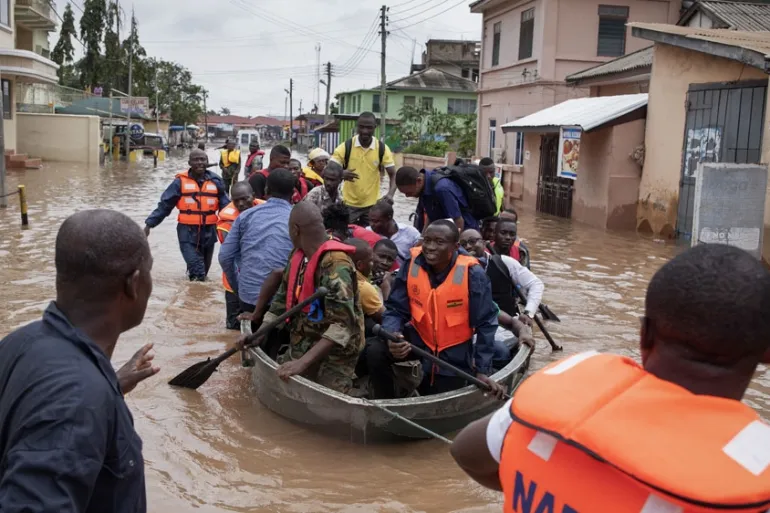

Every rainy season, the same scenes return.
Cars submerged in muddy water. Families stranded in their homes. Traders watching helplessly as floodwaters sweep through their shops. Politicians promise action. Experts call for better planning. Yet when the rains come again, Accra appears trapped in a cycle it cannot escape.
For years, many have blamed nature. Others point to climate change. Some focus on choked drains and indiscriminate construction.
But researchers from Columbia University’s Earth Institute and the Millennium Cities Initiative (MCI) arrived in Accra asking a more uncomfortable question: Why does the city continue to fail its residents in exactly the same way, year after year?
Their findings suggested that flooding in Accra is not primarily a natural disaster. Rather, it is the visible symptom of deeper governance failures that have accumulated over decades.
The researchers discovered that Accra had grown far beyond the systems designed to manage it.
The city’s population expanded rapidly, but planning institutions failed to keep pace. Departments responsible for physical planning, zoning, drainage management, and urban development were effectively working with assumptions and frameworks built for a much smaller city.
In simple terms, Accra outgrew the idea upon which it was planned.
As millions of people poured into the capital in search of opportunity, the infrastructure required to guide that growth never evolved at the same speed. The result was a city expanding faster than its own capacity to organize itself.
Yet population growth alone did not explain the crisis.
According to the Columbia researchers, one of the deepest challenges lay beneath the soil itself: land ownership.
Across communities such as Nima, Agbogbloshie, Glefe, and other rapidly developing areas, they repeatedly encountered a fundamental question that often lacked a clear answer: Who actually owns the land?
Ghana’s land system operates through two parallel structures. On one hand are customary ownership arrangements, where chiefs, stools, clans, and families maintain ancestral claims. On the other are statutory systems managed by state institutions responsible for issuing titles and legal documentation.
Both systems possess legitimacy within their respective frameworks. The problem emerges when they collide.
The researchers found that overlapping claims, boundary disputes, and uncertainty over ownership often created incentives for immediate construction. Buyers frequently rushed to build structures as quickly as possible to establish physical control over land, sometimes without permits, surveys, or adherence to planning regulations.
Buildings appeared on waterways. Structures emerged close to streams. Flood-prone zones became residential communities.
What looked like disorder from a distance often stemmed from people trying to secure their investments in an uncertain land environment.
Perhaps the most significant conclusion reached by the Columbia team was their challenge to a widely held assumption about informal settlements.
Contrary to popular belief, they argued that informality is not necessarily evidence of chaos or ignorance.
Many families settling in vulnerable areas understood the risks they faced. They knew the dangers associated with floodplains and poorly serviced communities. However, they were responding to a reality in which affordable housing options, clear land titles, and accessible formal development pathways were often unavailable.
Faced with a choice between risky shelter and no shelter at all, many chose the former.
The researchers described these decisions not as irrational behaviour but as rational responses to broken systems.
Their findings also challenged another common narrative surrounding flooding.
The issue, they argued, was not simply one of drainage.
It was also a sanitation crisis.
In many low-income communities, inadequate waste collection services meant that streams, gutters, and waterways gradually became informal waste disposal sites. Plastic waste, household refuse, and debris accumulated within drainage channels long before the rainy season arrived.
When heavy rains eventually fell, the consequences became predictable.
Waterways designed to carry stormwater could no longer perform their function effectively.
As a result, even moderate rainfall events had the potential to trigger severe flooding.
The researchers reached a striking conclusion: solving flooding would require solving sanitation, and solving sanitation would require addressing the inequalities that leave many communities outside formal municipal service delivery systems.
The study also cast a critical eye on Ghana’s urban planning framework itself.
According to the Columbia team, many of the planning tools being applied in Accra originated from colonial administrative systems and later evolved through Western planning models.
The challenge was not that these tools were inherently flawed. Rather, they were often designed for cities with conditions that Accra did not possess.
They assumed clear land ownership systems. They assumed strong enforcement mechanisms. They assumed formal housing markets accessible to ordinary citizens.
In reality, Accra’s social, legal, and economic landscape differed significantly from those assumptions.
Planning documents existed. Master plans existed.
But on the ground, the city frequently developed according to entirely different rules.
The researchers therefore reached a sobering conclusion.
Flood vulnerability in Accra is not randomly distributed. It is produced.
Communities with the least access to services, the weakest protection from the state, and the fewest economic alternatives often bear the greatest burden when disaster strikes.
The people suffering the most severe consequences are frequently those least capable of absorbing them.
Yet perhaps one of the most revealing aspects of the entire story emerged after the research itself.
According to accounts from individuals familiar with the process, the Millennium Cities Initiative struggled to fully advance its work in Accra because key stakeholders across multiple local assemblies were unable to sustain the level of coordination required.
Even opportunities for international collaboration reportedly failed to secure complete consensus among all the institutions involved.
Former Accra Mayor Alfred Oko Vanderpuije is said to have made efforts to drive cooperation, but the challenges persisted.
That detail may, in many ways, capture the central lesson of the Columbia findings.
Accra’s flooding problem is not ultimately about rain.
Rain merely exposes weaknesses that already exist.
The real challenge lies in fragmented governance, competing land systems, inadequate sanitation, weak enforcement, and the inability of institutions to work together around a shared vision for the city.
Until those deeper issues are addressed, the annual floodwaters will continue to arrive, carrying with them a painful reminder that the crisis facing Accra was never created by nature alone.
It was built over decades, one policy failure at a time.