
Ghana’s most celebrated lawyer delivered a powerful sermon on justice at UPSA. But someone needed to check the preacher’s own record.
There are men who grow in stature with age. And then there are men who grow in audacity.
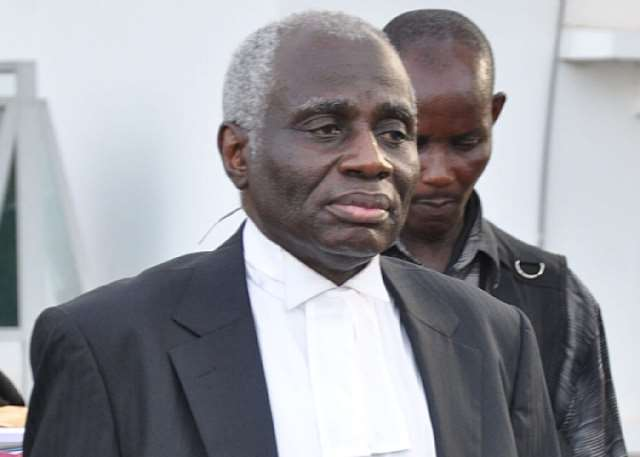
On April 15, 2026, Tsatsu Tsikata stood before a glittering gathering at the University of Professional Studies, Accra, draped in the warmth of a Lifetime Achievement Award, flanked by the Vice President and the Chief Justice, and delivered what his admirers called a masterclass on justice and judicial independence. “Political affiliation, settling political or personal scores, or wanting to show where power lies should not be the reason for criminal prosecution. Not even for a criminal investigation,” he told the assembled legal fraternity.
Ghana listened. Ghana applauded. But Ghana also remembers. And memory, as the man himself once said, is a long thing.
The Kufuor chapter: a story told in one direction only
Tsatsu Tsikata’s public persona in recent years rests heavily on one pillar: the injustice allegedly done to him by former President John Agyekum Kufuor. The telling never changes. On June 18, 2008, an Accra Fast Track High Court convicted him on three counts of wilfully causing financial loss to the state and one count of misapplying public property over a GNPC loan guarantee to Valley Farms. He was sentenced to five years.
He called the trial politically motivated. When Kufuor offered him a presidential pardon on his last day in office, Tsikata threw it back with memorable contempt, describing it as “the height of hypocrisy.” Strangely, after rejecting the pardon so dramatically, he did not remain in prison. He walked out of Nsawam and never returned. In November 2016, the Court of Appeal quashed the conviction and acquitted him on all four counts.
The system worked. But that part of the story rarely features in Tsikata’s victim narrative.
What also rarely features is this: he challenged the very constitutionality of the Fast Track Court all the way to the Supreme Court under President Kufuor. He lost. The courts and the president he accuses of manipulation were the same institutions that heard him through every level of appeal. A man who loses in court is not automatically a victim of the court. The distinction matters.
There is also the claim, repeated in NDC circles, that Kufuor stacked the Supreme Court by appointing two judges to influence his case. The record does not support this. Only Justice Kwame Afreh was promoted to the Supreme Court, and that appointment was made to give the court the constitutionally required odd number. One appointment, for procedural compliance, not a bench-stacking conspiracy.
The man who drove Kwesi Botchwey out
Roll back the clock further and the picture becomes less flattering still.
In 1995, after thirteen years as Ghana’s Finance Minister, the man most credited with stabilising Ghana’s collapsed economy under Rawlings, Prof. Kwesi Botchwey, walked out of the NDC government. Publicly, he cited policy disagreements. In NDC circles, the reason was far less abstract. It was widely believed that his departure resulted from fundamental differences between him and Tsatsu Tsikata, former Chief Executive of the Ghana National Petroleum Corporation, whose financial transactions at GNPC were thought to be having a negative impact on the economy but enjoyed the support of Rawlings.
The man who stabilised a collapsed economy decided he could not work in a government where GNPC operated above the Finance Ministry’s oversight. He had the integrity to leave. Tsatsu Tsikata, on the other hand, stayed and continued.
Ghana should sit with that for a moment. The man who today preaches institutional discipline and the public good was the reason Ghana’s most consequential Finance Minister resigned in disgust.
The 1982 judges: the silence that is loudest of all
Nothing in Tsatsu Tsikata’s career demands more honest reckoning than the events of June 30, 1982.
On that night, High Court Judges Cecilia Koranteng-Addo, Fred Poku Sarkodee, Kwadwo Agyei Agyepong, and retired Major Sam Acquah were abducted from their homes during curfew and murdered at the Bundase military range. Their crime was simple and devastating: they had freed suspects brought before them by the PNDC government. They did what independent judges are supposed to do. They paid for it with their lives.
The Special Investigation Board’s 1992 findings recommended the prosecution of ten individuals, including Capt. Kojo Tsikata, Rawlings’ national security advisor. At the National Reconciliation Commission, witness Joachim Amartey Kwei testified that he acted on orders from Capt. Kojo Tsikata and that Rawlings gave his approval. Tsatsu Tsikata served as counsel for Capt. Kojo Tsikata during the SIB trial. He has maintained he had nothing to do with the murders.
But here is the question that his UPSA audience was not asked to consider: the same PNDC regime Tsatsu Tsikata served and defended ran public tribunals that convicted citizens without due process. That very regime murdered judges for exercising exactly the kind of independent judicial judgment that Tsikata now champions from glittering podiums. The judges he eulogizes today as martyrs of the rule of law were killed by the government whose legal structures he helped build and defend.
“I have never sought, and I do not need your pretence of mercy,” he told President Kufuor. One wonders whether the families of Cecilia Koranteng-Addo and her colleagues have ever received that same fire on their behalf.
From victim to executioner: the Torkornoo affair
The final and most recent chapter is perhaps the most difficult to explain away.
Fast forward to 2025. Chief Justice Gertrude Torkornoo, the first Chief Justice appointed by an NPP government in a generation, found herself suspended and then removed under Article 146(9) following petitions to President Mahama. Tsatsu Tsikata announced himself as one of the lawyers representing the petitioners at the committee’s first sitting. The committee eventually found stated misbehaviour. President Mahama removed Chief Justice Torkornoo on September 1, 2025, hours after receiving the committee’s report.
The man who spent years painting himself as a victim of political pressure on the judiciary was now part of the legal machinery applying that very pressure to remove a sitting Chief Justice. Five cases challenging the constitutionality of the process were pending in court while the process continued. The Bar Council of England and Wales and the Commonwealth Lawyers Association called for her reinstatement before she was dismissed.
As lawyer Ayikoi Otoo observed at the time: “This incident sets a dangerous precedent that signals subordination of the judiciary to the executive arm of government.”
Where, at that moment, was Tsatsu Tsikata’s sermon about not showing where power lies?
The pattern
The through-line across six decades of public life is not complicated once you see it.
In the 1980s, he defended and served a regime that ran tribunals without due process and whose officials were implicated in the murder of judges who ruled against the government. In the 1990s, he ran GNPC so aggressively that Ghana’s most respected Finance Minister walked out rather than continue serving alongside him. In the 2000s, he was convicted, lost a Supreme Court challenge, rejected a pardon, walked out of prison, and later won on appeal, then rebuilt his entire public identity around victimhood. In the 2020s, he led the legal charge to remove a sitting Chief Justice and then stood at a university podium to lecture the nation on protecting judicial independence.
This is not hypocrisy in the conventional sense. It is something more consistent than that: a man who has always found himself on the right side of power, and always cast himself as the victim of it when power moved away from him.
Someone who backed and aided those who made laws and structures for the oppression of the people and the abuse of their human rights has no standing to preach about nonexistent grievances. There are real victims of machinations from that era, dead and alive, still waiting for the justice that Tsatsu Tsikata has spent decades politicising.
The UPSA audience deserved the full lecture. Not just the celebrated chapters, but all of them.
Ghana has a long memory. And so, on this occasion, should we.