
Most say rich people’s political influence is a big contributing factor
ByRichard Wike,Moira Fagan,Christine Huang,Laura ClancyandJordan Lippert
How we did this
A new Pew Research Center survey of 36 nations finds widespread public concern about economic inequality. And when asked what leads to this inequality, most people across the countries surveyed point to the intersection of wealth and politics.
The key findings of the survey include:
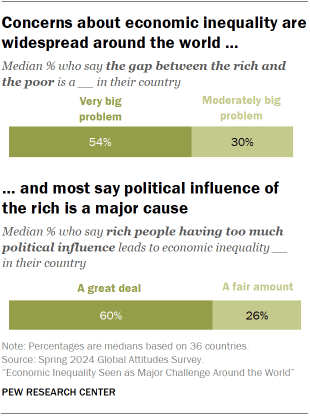
- A median of 54% of adults across the nations surveyed say the gap between the rich and the poor is a very big problem in their country. Another 30% say it is a moderately big problem.
- A median of 60% believe that rich people having too much political influence contributes a great deal toward economic inequality.
- These views are especially common among people on the ideological left, though many on the right agree. Ideological divisions are particularly large in the United States.
What is a median?
Throughout this report, median scores are used to help readers see overall patterns in the data. The median percentage is the middle number in a list of all percentages sorted from highest to lowest.
The survey, conducted in spring 2024, also finds deep global anxieties about the economic future and a strong desire for economic reform.
A median of 57% of adults across the nations polled expect children in their country to be worse off financially than their parents when they grow up.
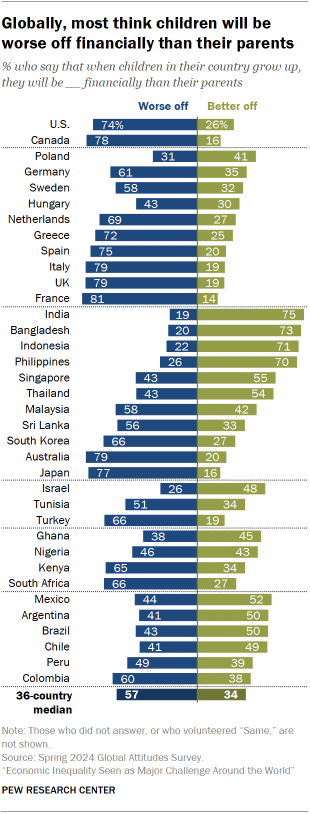
This view is particularly widespread in several high-income nations, including Australia, Canada, France, Italy, Japan, Spain, the United Kingdom and the U.S.
For the most part, this pessimistic view about the economic future is shared by younger and older adults alike, as well as by people with higher and lower incomes.
However, in several countries, the public is more optimistic than pessimistic about the financial prospects of the next generation. These include a few South Asian and Southeast Asian nations: Bangladesh, India, Indonesia, the Philippines, Singapore and Thailand.
And there is modest optimism in some Latin American nations, too. About half of those surveyed in Argentina, Brazil, Chile and Mexico think today’s children will be better off than their parents, while around four-in-ten or more say they will be worse off.
In many countries, there is more economic pessimism today than before the COVID-19 pandemic – which hurt many people economically. In 15 of 31 countries where trends are available, the share of the public who thinks children will be worse off financially than their parents is higher today than in pre-pandemic surveys.
Read more: The next generation’s financial future
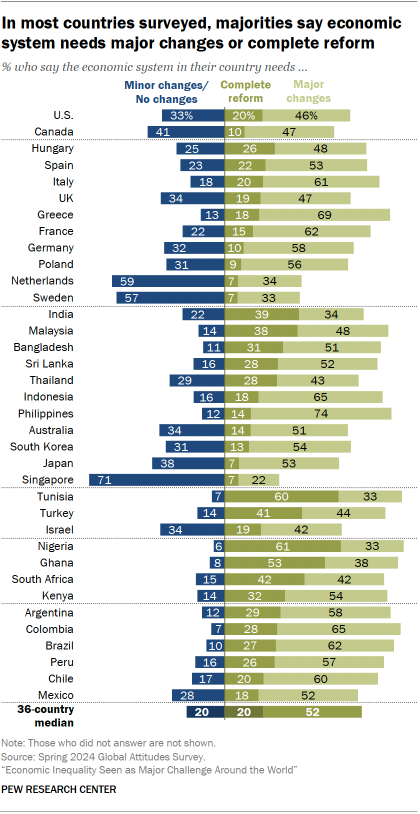
Majorities in 33 of 36 nations also think their country’s economic system needs major changes or complete reform. People in middle-income nations in the Asia-Pacific region, Latin America, sub-Saharan Africa and the Middle East-North Africa region are especially likely to want this degree of change.
Still, people in many wealthier countries want change, too. At least six-in-ten adults in most of the European nations surveyed want major economic changes or complete reform; 66% share this view in the U.S.
In almost every country polled, people who see economic inequality as a very big problem are significantly more likely than others to want major changes or complete economic reform.
Read more: Changing the current economic system
Perceived causes of economic inequality
What causes economic inequality? In our list of six potential factors, the strong connection between money and politics resonates most with respondents, topping the list in 31 of 36 countries.
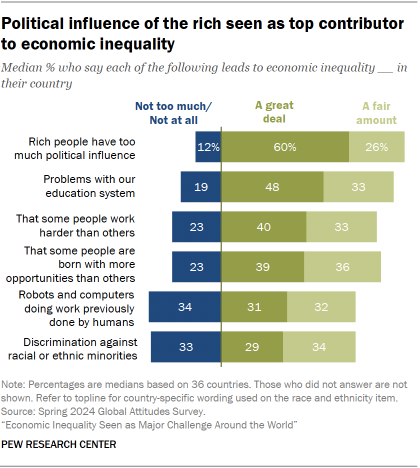
Overall, more than eight-in-ten adults say that rich people having too much influence over politics contributes to economic inequality either a great deal (60% at the median) or a fair amount (26%).
But respondents see other factors as important, too. Majorities across the countries surveyed believe problems with the education system add to inequality in their nation.
Many also attribute inequality to some people working harder than others or some being born with more opportunities. Smaller but still notable shares cite other factors, including robots and computers doing work previously done by humans, and discrimination against racial or ethnic minorities.
Economic anxiety during a global election year
Voters in more than 60 countries went to the polls in 2024. In many of these countries – including France, Japan, South Africa, the UK and the U.S. – incumbents lost or suffered major electoral setbacks. Economic concerns played a key role in these elections. For more, read our data essay: “Global Elections in 2024: What We Learned in a Year of Political Disruption.”
Read more: Factors seen as contributing to economic inequality
Views of other forms of inequality
Nearly a decade and a half after the Occupy Wall Street protests in the U.S. – which coincided with similar movements in other countries – economic inequality remains the reality in many nations.
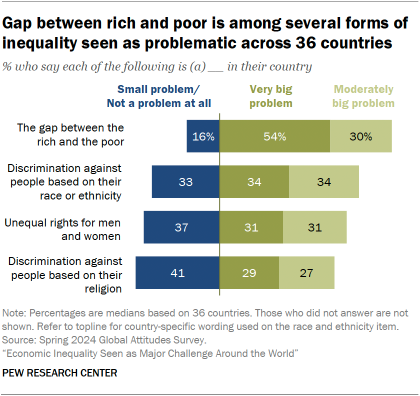
And as our survey highlights, this is a matter of strong public concern. More than eight-in-ten adults across the surveyed countries see the gap between rich and poor as a very or moderately big problem in their country.
But there’s concern about other forms of inequality as well. Roughly two-thirds say discrimination against people based on their race or ethnicity is a very or moderately big problem where they live, while about six-in-ten say this about gender inequality. And more than half describe discrimination against people based on their religion as a big problem.
Concerns about these issues are often tied to respondents’ demographic characteristics, background and experiences. For example, in some nations, people with lower incomes are especially worried about economic inequality; racial and ethnic minorities are more concerned about racial and ethnic discrimination; women are more concerned about gender inequality; and people who prioritize religion are more likely to see religious discrimination as a very big problem.
Read more: Global perceptions of different types of inequality
Ideological differences in views of economic inequality
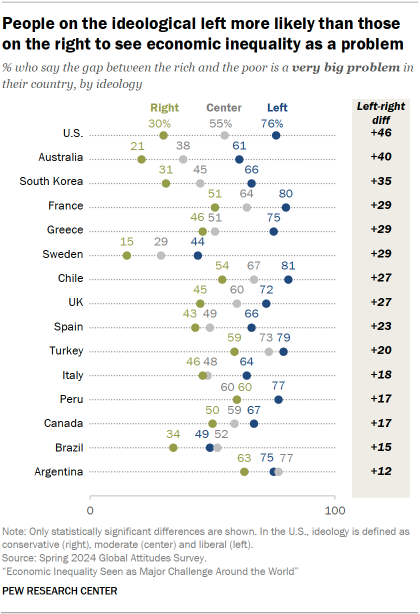
On several questions in this survey, opinions vary significantly by political ideology.
For instance, while concerns about inequality are common across the ideological spectrum, in many countries people who place themselves on the left are especially likely to say the gap between rich and poor is a very big problem.
Those on the left are also particularly likely to see racial and ethnic discrimination and gender inequality as very big problems.
And the same pattern appears when it comes to the perceived causes of inequality. People on the left are more likely than those on the right to cite the political influence of the rich, racial discrimination, and the fact that some are born with more opportunities than others.
Some of the largest ideological divisions in the survey are in the U.S. For example, 76% of U.S. liberals say economic inequality is a very big problem in their country, compared with just 30% of conservatives. This 46 percentage point gap is the largest left-right differences across the countries surveyed. (The survey was conducted prior to the November 2024 U.S. presidential election.)
Views of inequality in middle- and high-income nations
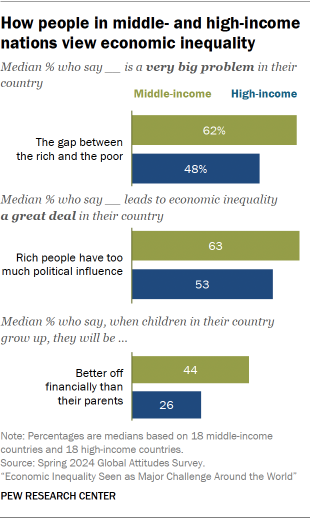
The survey finds important differences between middle- and high-income nations in attitudes about income inequality.
(We surveyed 18 middle-income countries and 18 high-income countries. Read Appendix A for a classification of these nations.)
While concerns about economic inequality are widespread in all the countries surveyed, people in middle-income nations are especially likely to describe it as a very big problem. They are also more likely to say that the rich having too much political influence is a major cause of inequality.
But when it comes to views about the economic future, people in middle-income nations are somewhat more positive. A median of 44% of adults in middle-income nations believe that when children in their country grow up, they will be financially better off than their parents. A median of just 26% in wealthier nations express this view.