
Monday, 6 Jul 2026
  • About us
  • Our policy
  • Blog
  • Contact
Subscribe
thepatriotnewsonline.com
  • Home
  • Politics

    SYLVESTER TETTEH VOWS TO REBUILD NPP STRUCTURES AHEAD OF 2028

    By Agyemkum Tuah

    GOVERNMENT’S HIGH-HANDEDNESS EXPOSED: HANAN’S AIRPORT ARREST SHOWS WITCH-HUNT OF FORMER NPP APPOINTEES

    By Agyemkum Tuah

    GOVERNMENT FULLY RESPONSIBLE FOR ACCRA FLOODING CRISIS – MIRACLES ABOAGYE

    By Agyemkum Tuah

    NPP Demands Full Disclosure Over Mahama Government’s Acquisition of Refurbished Locomotives

    By Thepatriotnewsgh

    Ghana records weakest Q1 budget execution since 2017 as consolidation bites

    By Thepatriotnewsgh

    BAWUMIA DONATES RELIEF ITEMS TO JUNE 29 ACCRA FLOOD VICTIMS

    By Agyemkum Tuah
  • Business
  • Opinion

    School Funding in a Tight Economy: What Political Choices Mean for Ghana’s Classrooms

    By Agyemkum Tuah

    Halt takeover of Damang Gold Mine – ACEP to govt

    By Thepatriotnewsgh

    NPP/UP Tradition the Custodian of Best Single Digit Inflation Data in Ghana

    By Thepatriotnewsgh

    Mahama gov’t fails to meet governance & accountability promises after 120-days – Says IERPP’s Executive Director

    By Thepatriotnewsgh

    Madina Court Frees Suspect in Ahmed Suale Murder Case After Charges Dropped

    By Agyemkum Tuah

    Gaza Ceasefire Begins with IDF Partial Withdrawal

    By Agyemkum Tuah
  • Health

    GOVERNMENT FULLY RESPONSIBLE FOR ACCRA FLOODING CRISIS – MIRACLES ABOAGYE

    By Agyemkum Tuah

    ‘EVERY GHANAIAN LIFE MATTERS’ – DACOSTA ABOAGYE CALLS FOR STATE MOURNING OVER FLOOD DEATHS

    By Agyemkum Tuah

    CIKOD RAISES ALARM OVER PESTICIDE RESIDUES IN CABBAGE SOLD ON GHANAIAN MARKETS

    By Agyemkum Tuah

    BAWUMIA’S CALL FOR STATE OF EMERGENCY OVER FLOODS IS JUSTIFIED – MANHYIA SOUTH MP

    By Agyemkum Tuah

    MINORITY SEEKS URGENT UPDATE ON DISEASE PREVENTION IN FLOOD-HIT COMMUNITIES

    By Agyemkum Tuah

    AGENDA 111 PROJECT IN ADANSI ASOKWA UNDER SIEGE AS ILLEGAL MINERS TAKE OVER LANDS

    By Agyemkum Tuah
  • Pages
    • About us
    • Our policy
    • Contact US
  • Health
  • Sports
  • World
  • Lifestyle
  • Travel
  • Health
  • Sports
  • World
  • Lifestyle
  • Travel
Font ResizerAa
thepatriotnewsonline.comthepatriotnewsonline.com
  • My Saves
  • My Interests
  • My Feed
  • History
  • Travel
  • Opinion
  • Politics
  • Health
  • Technology
  • World
Search
  • Home
  • Politics
  • Business
  • Sports
  • Opinion
  • Health
  • Travel
  • World
Have an existing account? Sign In
Follow US
© The Patriot News Network. All Rights Reserved.

Home » Ghana’s Cocoa Future Requires a Radical Policy Shift: Eight Priorities for Building Climate-Resilient Producers

AgricultureAgriculture and AgribusinessEconomy

Ghana’s Cocoa Future Requires a Radical Policy Shift: Eight Priorities for Building Climate-Resilient Producers

Thepatriotnewsgh
Last updated: July 6, 2026 11:06 am
Share
SHARE

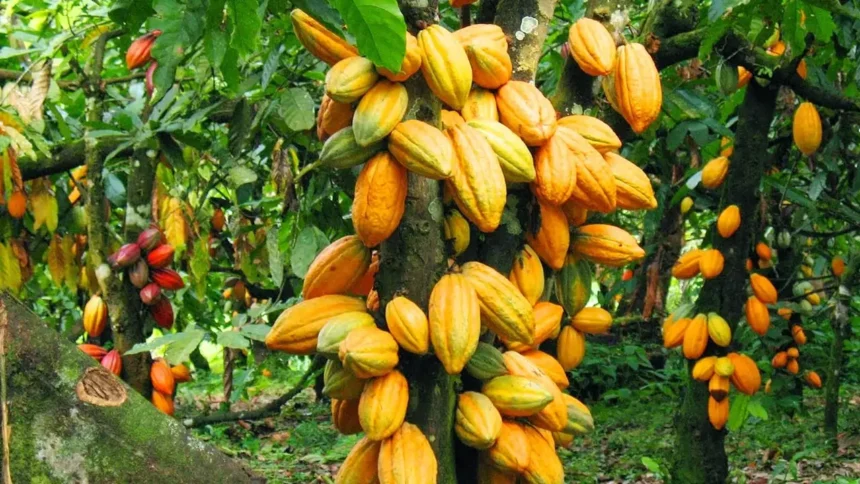
For decades, policymakers, industry actors, researchers and development partners have focused on a familiar challenge: how to protect cocoa trees and increase cocoa production. Significant investments have been made in mass spraying, disease control, rehabilitation programmes, improved planting materials, artificial pollination, extension services and, more recently, efforts to improve farmer incomes through initiatives such as the Living Income Differential (LID).

Yet despite these interventions, Ghana’s cocoa sector continues to face mounting difficulties. National production has fallen from historical averages of around 800,000 tonnes to approximately 600,000 tonnes in recent years. Farmers continue to report declining yields, increasing production costs, labour shortages, and growing uncertainty about the future of cocoa farming. The question is obvious: why does vulnerability remain so high despite substantial investments?

New research conducted in Ghana and Côte d’Ivoire suggests that we may be asking the wrong question. Climate change is no longer only a threat to cocoa production; it is increasingly becoming a threat to cocoa producers themselves.

Across cocoa-growing communities, farmers consistently report rising temperatures, prolonged droughts, erratic rainfall, physical exhaustion, reduced working hours and increasing anxiety about their livelihoods. Many struggle to implement adaptation measures because they lack the necessary financial resources. Others are questioning whether cocoa farming remains a viable livelihood under increasingly unpredictable climatic conditions.

The implications are profound. If cocoa producers become less healthy, less productive and less able to adapt, then no amount of investment in cocoa trees alone will secure the future of the sector. What Ghana needs is a fundamental shift from a yield-centred climate policy to a producer-centred climate policy. Such a shift does not mean abandoning productivity goals. Rather, it recognizes a simple reality: a climate-resilient cocoa sector requires climate-resilient cocoa producers.

Eight priorities should guide this transition.

First, we must move from a narrow focus on yields to a broader focus on producer resilience. Success should not be measured solely by tonnes of cocoa produced but also by whether farmers are becoming healthier, more adaptive and better able to withstand climate shocks.

Second, climate adaptation must complement price and income interventions. Higher farmgate prices remain essential, but prices alone cannot offset climate-related production losses. Living incomes increasingly depend on living resilience.

Third, Ghana must invest more aggressively in climate-smart water management. Water harvesting systems, community reservoirs, moisture conservation measures and carefully targeted irrigation pilots can help farmers cope with prolonged dry spells and increasing rainfall variability.

Fourth, adaptation should be treated as an investment challenge rather than simply an information challenge. Farmers often know what needs to be done but lack the financial means to implement adaptation measures. Climate adaptation financing should therefore become a central pillar of cocoa policy.

Fifth, greater attention must be given to farmer health and labour productivity. Heat stress, physical exhaustion and declining work capacity are emerging risks that directly affect production. Climate adaptation should include occupational health measures, labour-saving technologies and interventions that reduce the physical burden of cocoa farming.

Sixth, adaptation support must move beyond information delivery towards practical implementation support. Training is important, but knowledge alone cannot overcome financial barriers, labour shortages or infrastructure deficits.

Seventh, farmers must have a stronger voice in cocoa governance. Too often, policies are designed for farmers rather than with farmers. Meaningful participation in policy design, implementation and monitoring can improve both legitimacy and effectiveness.

Finally, cocoa resilience should be viewed as a national economic resilience issue. Cocoa remains one of Ghana’s most important export commodities and a major source of rural livelihoods. Strengthening producer resilience is therefore not merely an agricultural objective; it is an economic and development imperative.

Some may argue that the answer lies simply in increasing cocoa prices. Higher prices are indeed important and should remain part of the solution. However, climate change is increasingly reducing the volume of cocoa that farmers are able to produce and sell. A farmer who harvests fewer bags because of drought or heat stress cannot fully benefit from higher prices. This is why income policies and adaptation policies must work together rather than compete for attention.

The future of Ghana’s cocoa sector will not be determined solely by the health of cocoa trees. It will also be determined by the health, wellbeing, productivity and resilience of the farmers who cultivate them.

The sustainability debate must therefore evolve. We can no longer focus exclusively on protecting cocoa production. We must also protect cocoa producers. The evidence is becoming increasingly clear: Ghana’s cocoa future depends not only on climate-resilient farms, but on climate-resilient farmers. The sooner our policies reflect this reality, the better positioned the country will be to secure the future of one of its most important sectors.

Dr Albert Arhin is a Development Consultant, Sustainability Researcher and Research Fellow of the Institute for Rural Development and Innovation Studies (IRDIS), Kwame Nkrumah University of Science and Technology, Ghana. His email address is: [email protected]. Richard Tetteh is a Research Consultant and an Associate at the Institute for Rural Development and Innovation Studies (IRDIS), Kwame Nkrumah University of Science and Technology, Ghana.

Disclaimer: The content published on this website is for informational purposes only. The views, opinions, and positions expressed by individual authors or contributors are theirs alone and do not necessarily reflect those of [patriotnewsonline.com]. While every effort is made to ensure accuracy, [patriotnewsonline.com] does not assume any responsibility or liability for any errors, omissions, or outcomes resulting from the use of this information. Readers are advised to verify facts independently and seek professional advice where necessary.

Share this:

  • Share on Facebook (Opens in new window) Facebook
  • Share on X (Opens in new window) X
Share This Article
Email Copy Link Print
Previous Article Alan Greenspan, architect of the modern American economy, dies aged 100
Next Article Sentuo Built and Began Operations Of Its Oil Refinery On a Wetland Despite EPA Objections. Then It Ran Into New Controversy
Leave a Comment

Leave a Reply Cancel reply

Your email address will not be published. Required fields are marked *

Your Trusted Source for Accurate and Timely Updates!

Our commitment to accuracy, impartiality, and delivering breaking news as it happens has earned us the trust of a vast audience. Stay ahead with real-time updates on the latest events, trends.
FacebookLike
XFollow
InstagramFollow
LinkedInFollow
MediumFollow
QuoraFollow
- Advertisement -
Ad image

Popular Posts

REJOINDER: Stop the Lazy Blame Game — Ken Ofori-Atta Did Not Bring Ghana to Its Knees Alone

By Citizen Kofi Adu-BaahLet’s get something straight — Ghana didn’t collapse because of one man.…

By Thepatriotnewsgh

CLOGSAG begins indefinite nationwide strike today despite NLC’s order

Barring any last-minute change, the Civil and Local Government Staff Association, Ghana (CLOGSAG) is expected…

By Agyemkum Tuah

NPP internal election: local legal panels deployed to reduce disputes, says Nimako

The New Patriotic Party’s (NPP) legal directorate is being deployed nationwide to oversee internal election…

By Agyemkum Tuah

You Might Also Like

BusinessEconomyNews

T-bills: Government’s target undersubscribed by 55%; interest rates rise

By Agyemkum Tuah
BusinessEconomyPolitics

Kwadwo Poku: Government facing deep financial crisis amid cocoa revenue woes

By Thepatriotnewsgh
BusinesscorruptionEconomyEnergyPolitics

ECG Containers: IERPP cites leadership failure, tells Energy Minister to take full responsibility

By Thepatriotnewsgh
BusinessEconomyEnergyNews

Ghana’s Petroleum Revenue Plunges 56% in First Half of 2025, PIAC Report Reveals

By Agyemkum Tuah
thepatriotnewsonline.com
Facebook Twitter Youtube Rss Medium

About US

ThePatriotnewsonline.com: Your instant connection to breaking stories and live updates. Stay informed with our real-time coverage across politics, tech, entertainment, and more. Your reliable source for 24/7 news.

Top Categories
  • World
  • Opinion
  • Politics
  • Tech
  • Health
  • Travel
Usefull Links
  • Contact Us
  • Advertise with US
  • Complaint
  • Privacy Policy
  • Cookie Policy
  • Submit a Tip

© The Patriot News Network.

All Rights Reserved.

Welcome Back!

Sign in to your account

Username or Email Address
Password

Lost your password?