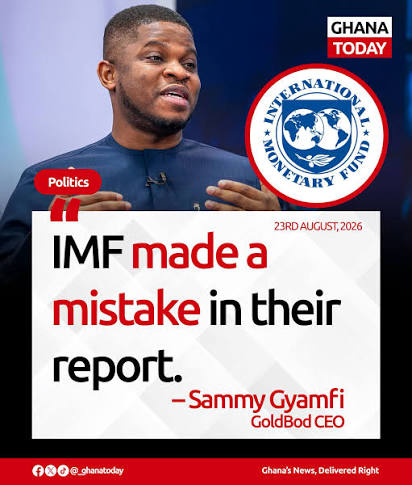

For years, the International Monetary Fund was one of the most frequently cited authorities by Ghana’s opposition National Democratic Congress whenever it wanted to make the case that the Akufo-Addo administration had mishandled the economy. IMF assessments were presented as independent confirmation of the NDC’s warnings about debt, deficits, inflation and economic mismanagement. Now, however, Sammy Gyamfi, the Chief Executive Officer of GoldBod, is asking Ghanaians to look at an IMF report and conclude that the Fund’s interpretation is being misrepresented. That raises an uncomfortable question for the GoldBod chief: when exactly did the IMF stop being the authoritative source it appeared to be when his party was in opposition?
The immediate dispute concerns the IMF’s assessment of Ghana’s Domestic Gold Purchase Programme. In its August 2026 Selected Issues report, the Fund said the rapid expansion of the programme in 2025 coincided with significant macroeconomic gains but also generated losses of more than US$1.7 billion, equivalent to about 1.5 per cent of GDP. The IMF was careful about what it was describing. It said the losses were incurred by the Bank of Ghana under the Domestic Gold Purchase Programme, not that GoldBod, as a corporate entity, had itself recorded a US$1.7 billion loss.
That distinction gives Mr Gyamfi a legitimate point, and it should be acknowledged. The IMF report does not say, in the simple language being used in the political debate, that “GoldBod lost US$1.7 billion.” The report says the Bank of Ghana’s DGPP generated losses of more than US$1.7 billion in 2025. It further explains that these losses arose from several factors, including service and assay fees, discounts, trading costs and, importantly, the difference between the foreign exchange rate used to purchase gold and the Bank of Ghana’s reference rate used for accounting. The IMF also states that some of the losses partly reflected valuation effects rather than straightforward economic costs.
But Mr Gyamfi’s response becomes politically interesting when he moves from correcting the interpretation of the IMF report to challenging the authority of the Fund itself. His now familiar question, “What does IMF know about profit and losses?”, is a striking departure from the reverence with which IMF assessments were routinely deployed by the NDC while it was in opposition. The irony is difficult to miss. When the IMF’s numbers supported the opposition’s argument that Ghana’s economy was in trouble, the Fund’s reports were presented as independent evidence against the government. When the IMF now publishes figures that create an uncomfortable conversation around a flagship policy of the NDC government, its methodology suddenly becomes a subject for interrogation.
That does not mean the IMF is infallible. It is not. IMF assessments are produced by economists and technical teams, and their conclusions can and should be scrutinised. Governments are entitled to challenge the Fund’s assumptions, methodology and interpretation. Mr Gyamfi is therefore perfectly entitled to disagree with the IMF. The problem is consistency. If an institution’s data is credible only when it supports one’s political argument, then the real issue is not the IMF. It is the standard being applied by the politician.
Consider the record. In opposition, Mr Gyamfi repeatedly relied on reports from international institutions and independent state bodies to attack the Akufo-Addo government. In February 2023, for instance, when addressing the NDC’s “Moment of Truth” press conference on COVID-19 expenditure, he cited funds received from the IMF, World Bank and other international institutions while making a case for alleged mismanagement of public resources. His political messaging during that period routinely presented external assessments and official reports as evidence that the government had failed the country.
The NDC’s broader economic argument during the Akufo-Addo years also leaned heavily on external assessments of Ghana’s fiscal position. Mr Gyamfi himself publicly attacked the then government over debt, deficits and economic management, presenting figures and assessments as proof that the NPP had taken Ghana in the wrong direction. The point is not that he was wrong to criticise the government. Opposition parties are expected to scrutinise governments. The point is that the credibility of evidence cannot reasonably depend on which political party happens to benefit from it.
Today, the political circumstances have changed. Mr Gyamfi is no longer sitting behind a microphone as the NDC’s opposition communications officer. He is the CEO of GoldBod, a powerful state institution at the centre of Ghana’s gold policy. That institutional position makes his current defence understandable, but it also places a higher burden on him to separate political advocacy from financial explanation.
And there is a substantive issue that should not be lost in the political noise. GoldBod did not bear the entire responsibility for the 2025 programme in the way some of its critics have suggested. GoldBod says its role at the time was principally that of a buying agent for the Bank of Ghana, continuing an arrangement inherited from the former Precious Minerals Marketing Company. It says it purchased and aggregated gold for the central bank but did not determine the subsequent selling prices or negotiate the off-take arrangements that generated the losses. It says it accounted for approximately GH¢133 billion advanced to it for gold purchases.
The IMF’s own report broadly supports part of that distinction. It says the programme was operated by the Bank of Ghana until its transfer to GoldBod and that the Bank incurred the reported losses. From July 2026, GoldBod and government assumed responsibility for the programme’s operations and costs, while the Bank of Ghana’s exposure to the operational risks was reduced.
Yet this does not make the US$1.7 billion figure meaningless. That is where Mr Gyamfi’s defence should be tested more rigorously. Whether the loss sits on the balance sheet of the Bank of Ghana, the government or another public institution, the underlying question remains: what happened to the public resources represented by that loss? A change in accounting ownership does not make the economic cost disappear.
The IMF itself makes this clear. It says the losses weakened the Bank of Ghana’s balance sheet and that the programme created quasi-fiscal risks. It also says the expansion of the programme contributed to a remarkable increase in gold exports, reserve accumulation and foreign exchange availability. In other words, the Fund did not present a simple story of failure. It identified both benefits and costs.
That is perhaps the most important part of the debate. Ghana does not have to choose between pretending the programme was perfect and declaring it a disaster. The IMF’s own assessment is more nuanced. The programme helped export US$10.9 billion in artisanal gold in 2025 and contributed to macroeconomic stabilisation, but it also generated substantial losses.
Mr Gyamfi should therefore be challenged on a simple matter of principle. If he believes the IMF is wrong, he should explain precisely where. If he believes the Fund’s accounting methodology is defective, he should produce the alternative methodology. If the US$1.7 billion is largely a valuation effect rather than a cash loss, as the IMF itself partly acknowledges, then that distinction should be demonstrated with audited figures. What cannot be allowed is for the public debate to become another contest in which the IMF is credible when its numbers help one political side and suddenly questionable when they create difficulties for the other.
Ghana needs a more mature economic conversation than that.
The GoldBod programme may yet prove to be one of the more consequential economic interventions of the Mahama administration. Its contribution to foreign exchange supply and reserve accumulation deserves proper recognition. But that recognition cannot be purchased by dismissing every uncomfortable figure. Likewise, criticism of the programme cannot be justified by simply attaching every loss recorded under the DGPP to GoldBod without examining the structure of the programme and the timing of the institution’s involvement.
Mr Gyamfi is right to demand that critics quote the IMF accurately. But the same standard should apply to him. The IMF should neither be worshipped nor ridiculed. Its claims should be tested against the evidence.
And perhaps that is the question Ghanaians should put to the GoldBod CEO: if the IMF was credible enough to strengthen the opposition’s case against the NPP for years, what has changed now that its report is making the NDC government uncomfortable?