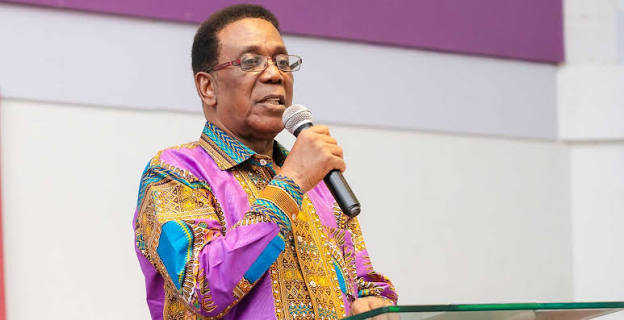

Ghana’s democratic journey may be more than three decades old, but concerns over free expression are once again occupying public space, with former Education Minister and academic Professor Kwesi Yankah warning that the country risks creating a culture in which ordinary citizens become afraid to speak.
In a strongly worded Facebook article titled “The Vulture of Silence,” Prof. Yankah reflects on recent arrests linked to alleged insults against President John Dramani Mahama and argues that the response of the state should not create an atmosphere where citizens feel they must seek permission before expressing their frustrations.
He draws particular attention to the voices of women who recently took part in a street demonstration. According to Prof. Yankah, the women were less concerned with political rhetoric than with the hardships confronting them in their daily lives. Their complaints centred on poor sales, economic pressure and what they described as widespread arrests.
One woman, visibly emotional, appealed to the President to clarify whether freedom of speech had effectively been withdrawn. Another pleaded with the President to stop what she described as the “rampant arrests” of citizens. An elderly man, in a lighter moment, reportedly declined to comment on the President but simply asked Mahama to buy him a car.
For Prof. Yankah, however, the humour masks a deeper democratic concern.
He argues that the fear expressed by the women is particularly significant because ordinary citizens, especially those with limited access to formal political platforms, depend heavily on public spaces and social media to make their voices heard. He questions whether Ghana has created sufficient avenues for people outside elite political and institutional circles to express themselves freely.
Prof. Yankah also takes a historical look at Ghana’s political culture, recalling periods when politicians were subjected to fierce ridicule and sometimes deeply personal attacks without the state responding with arrests.
He cites former Prime Minister Kofi Abrefa Busia, who, according to his account, routinely passed through Kaneshie Market without a heavy convoy and endured market women chanting the insulting expression “Busia Naabu”, a reference to his physical appearance. Yet, Prof. Yankah says, there were no reports of police being ordered to arrest the women for their insults.
He also recalls how the late President Edward Akufo Addo became the subject of popular jokes because of his physical appearance, including the use of his name as a nickname for a local beer. Again, he presents the episode as an example of a political culture in which leaders were expected to develop thick skins.
The article further recalls some of the more extreme political expressions that have appeared in Ghana since the beginning of the Fourth Republic, including death wishes directed at political leaders during election campaigns and demonstrations.
Prof. Yankah points to the “Kill JJ for us” chants associated with the 1996 Kumi Preko demonstration and other abusive political songs directed at Nana Addo Dankwa Akufo Addo and Dr Mahamudu Bawumia. He also recalls the controversy involving eight schoolgirls from Chiana who, in 2023, were dismissed after a social media video containing offensive remarks about President Akufo Addo triggered public outrage.
His argument is not that such language should be celebrated.
Indeed, Prof. Yankah makes clear that vulgar insults and obscenities are unacceptable in civilised public discourse. His concern is where the line should be drawn between offensive speech and criminal conduct, particularly in an age where social media has dramatically changed the way political expression takes place.
He recalls that President Akufo Addo, despite being subjected to severe insults during his administration, was often seen as adopting a thick skinned approach to political criticism. Prof. Yankah also cites an instance in which then Vice President Bawumia reportedly intervened after the arrest of a blogger, seeking the person’s release.
Against that background, he questions whether the current response to offensive speech risks moving Ghana towards a more restrictive political culture.
For him, the issue is larger than President Mahama or the individuals who may have crossed the line with their language. It concerns the health of Ghana’s democratic culture and whether citizens can criticise those in power without becoming paralysed by fear.
The constitutional protection of freedom of expression and the media, he notes, remains a central pillar of Ghana’s Fourth Republic. While freedom of expression cannot reasonably be interpreted as a licence to defame, threaten or commit offences, Prof. Yankah argues that political leaders must also recognise that public office comes with criticism, ridicule and even offensive commentary.
His warning is captured in the phrase that gives his article its title: “The Vulture of Silence.”
Prof. Yankah fears that if citizens begin to believe that criticism of those in power could result in arrest, they may choose silence instead. And when ordinary citizens stop speaking, he suggests, democracy loses one of its most important safeguards.
“Kurom ayɛ dinn,” he repeatedly writes, meaning the town has become silent.
For the veteran academic, that silence should concern everyone, regardless of political affiliation. Ghana’s democratic gains, he argues, were built by generations of journalists, activists, politicians and ordinary citizens who insisted on the right to question authority.
The challenge for the present generation is whether those freedoms will remain sufficiently robust to accommodate even speech that is uncomfortable, rude or politically inconvenient.
Prof. Yankah’s conclusion is unmistakable: Ghana cannot afford a democracy in which the citizen’s first instinct, before speaking, is to wonder whether the police are coming.