
In April 1960, a curious request landed on the desk of American authorities.
French President Charles de Gaulle, one of the most celebrated leaders of the Second World War, was on a visit to the United States and wanted help finding a man. This was no ordinary search. The individual he sought was an American citizen who had fought bravely for France, survived two world wars and received some of the country’s highest military honours. Only months earlier, de Gaulle himself had decorated the man in Paris, publicly describing him as “a true French hero.”
Yet there was one problem.
Nobody seemed to know where he was.
Within days, the Federal Bureau of Investigation tracked him down in New York City. The discovery stunned many. The man whom France regarded as a national hero was operating an elevator at Rockefeller Center.
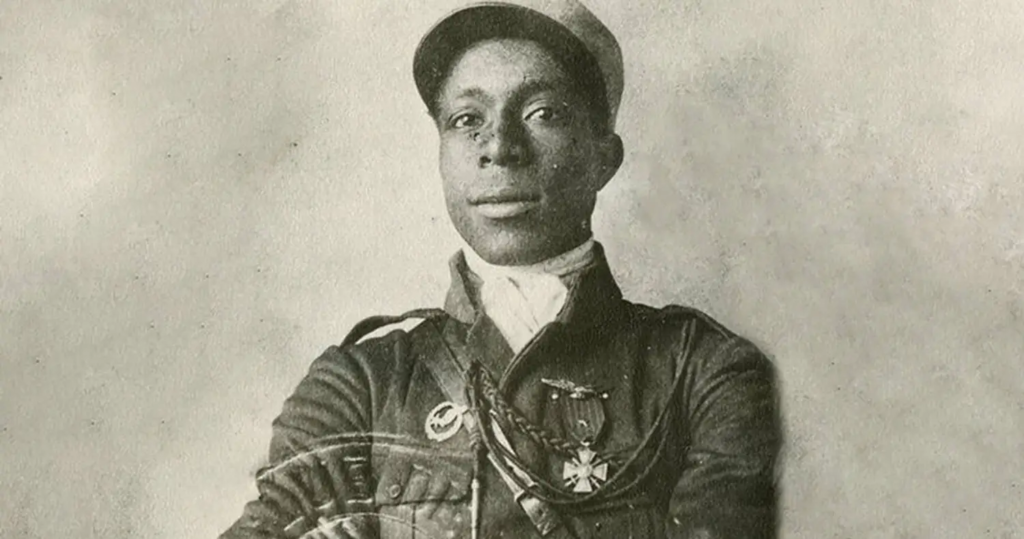
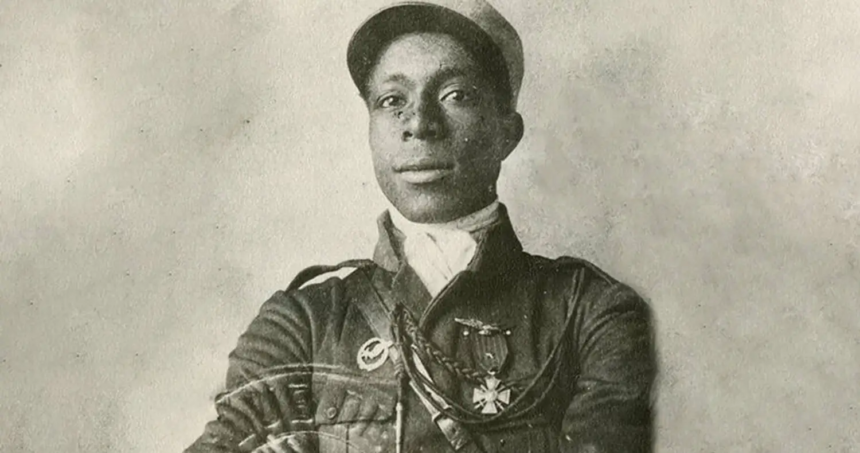
His name was Eugene Jacques Bullard.
Today, more than sixty years after his death, Bullard remains one of the most remarkable yet least celebrated figures in American military history. His story is one of courage, resilience and determination. It is also a story that exposes the painful contradictions of race and recognition in the twentieth century.
Born in Columbus, Georgia, on October 9, 1895, Bullard entered a world deeply scarred by the legacy of slavery. His grandfather had been enslaved, and his family lived under the harsh realities of racial segregation in the American South. As a child, Bullard often listened to his father’s stories about France, a country he described as a place where people were judged less by the colour of their skin.
Those stories would stay with him.
At the age of eleven, after witnessing a white mob nearly lynch his father, Bullard ran away from home. It was a decision that would set him on an extraordinary journey. For several years he drifted across the American South, taking odd jobs and surviving however he could. Eventually, as a teenager, he stowed away aboard a German freighter leaving Norfolk, Virginia.
The ship carried him across the Atlantic.
After arriving in Scotland and spending time in Britain, Bullard learned boxing and earned a modest living in the ring. By 1913, he had settled in Paris, a city that offered opportunities and freedoms he had never experienced in America.
Then came war.
When Germany invaded France in August 1914, thousands of Frenchmen rushed to defend their country. Bullard was not French. He had no obligation to fight. Yet on October 19, 1914, the nineteen-year-old volunteered for service in the French Foreign Legion.
The decision would change his life forever.
Bullard soon found himself in some of the bloodiest battles of the First World War. He fought at Champagne, the Somme and Verdun, where hundreds of thousands of soldiers were killed or wounded. The conditions were horrific. Men lived for weeks in muddy trenches under relentless artillery bombardment.
Through it all, Bullard distinguished himself through bravery and determination.
The war, however, exacted a heavy toll. He was wounded three times. The third injury, suffered in March 1916 during the Battle of Verdun, severely damaged his leg and ended his career as an infantryman. Doctors informed him that he would never return to front-line ground combat.
For many soldiers, that would have marked the end of military service.
For Bullard, it was the beginning of a new chapter.
While recovering in Paris, he developed an ambition that many considered impossible. He wanted to become a military pilot. At a time when aviation was still in its infancy and opportunities for Black men were virtually non-existent, the idea was greeted with disbelief.
One American acquaintance reportedly laughed at the suggestion and wagered that Bullard would never succeed.
Bullard accepted the challenge.
On May 5, 1917, he earned his pilot’s licence and entered history. He is widely recognised as the first Black combat pilot in military aviation history.
Assigned to the French Air Service, Bullard flew combat missions over the Western Front in a SPAD VII fighter aircraft. The aircraft carried a striking emblem, a bleeding heart pierced by a knife, alongside the words: “All Blood that Flows is Red.”
The slogan reflected a simple but powerful belief. In the skies above Europe, courage and sacrifice mattered far more than race.
Ironically, it was France that gave Bullard the opportunity to fly, not the country of his birth.
When the United States entered the war in 1917, Bullard eagerly applied to join the U.S. Army Air Service. Despite already being a trained combat pilot with front-line experience, his application was rejected. The American military at the time did not accept Black pilots. White American aviators serving alongside him in France were transferred into U.S. service.
Bullard was left behind.
The rejection highlighted a reality that would follow him throughout much of his life. While France celebrated his achievements, America largely ignored them.
After the war, Bullard chose to remain in Paris. During the 1920s and 1930s, he became a prominent figure in the city’s vibrant social and cultural scene. He owned and managed a popular nightclub called L’Escadrille, which attracted writers, artists, musicians and celebrities from around the world.
Among those who passed through its doors were Ernest Hemingway, F. Scott Fitzgerald, Langston Hughes and Josephine Baker. Jazz icon Louis Armstrong was counted among Bullard’s friends.
Yet once again, war would interrupt his life.
When Germany invaded Poland in 1939 and Europe moved toward another devastating conflict, Bullard once more offered his services to France. Fluent in German and well connected within Parisian society, he quietly gathered intelligence from German officers who frequented his nightclub, passing valuable information to French authorities.
As Nazi forces swept into France in 1940, members of the French Resistance helped him escape before he could be arrested by the Gestapo.
After nearly three decades abroad, Bullard returned to the United States.
The homecoming was far from triumphant.
He arrived in New York carrying little more than thirty dollars and the physical scars of war. The country he returned to scarcely knew his name. The decorated veteran who had risked his life for freedom struggled to make ends meet. He worked various jobs, including security work and employment in shipyards.
Eventually, he became an elevator operator at Rockefeller Center.
There was a certain irony in the situation. Every day, Bullard transported executives, media personalities and business leaders to their offices. Most had no idea that the quiet man operating the elevator had once flown combat missions over Europe and earned numerous military decorations for bravery.
For years, he remained largely invisible.
It took the intervention of Charles de Gaulle in 1960 to briefly shine a spotlight on his extraordinary life. Following the French president’s search for him, television crews and journalists finally began telling a story that should have been widely known decades earlier.
The attention, however, came late.
Bullard died of stomach cancer on October 12, 1961, just three days after his sixty-sixth birthday. He was buried in New York wearing the uniform of the French Foreign Legion, with a French flag draped over his coffin.
Even in death, it was France that most visibly honoured him.
America’s recognition arrived much later. In 1994, thirty-three years after his death, the United States Air Force posthumously commissioned Eugene Jacques Bullard as a Second Lieutenant. It was the first commission the U.S. military had ever granted him.
The gesture was significant, but it also carried an uncomfortable truth.
The French had recognised Eugene Bullard’s heroism during his lifetime. They celebrated him, decorated him and remembered him. America, by contrast, waited until long after he was gone.
Today, Bullard’s life stands as both an inspiring story of perseverance and a sobering reminder of how easily history can overlook its heroes. The image remains striking: a man decorated by presidents, revered by a foreign nation and hailed as a pioneer of military aviation, quietly operating an elevator in New York while thousands passed him by without ever knowing his name.
It took a French president to ask where Eugene Bullard was.
Perhaps the more important question is why so few Americans had asked before.