
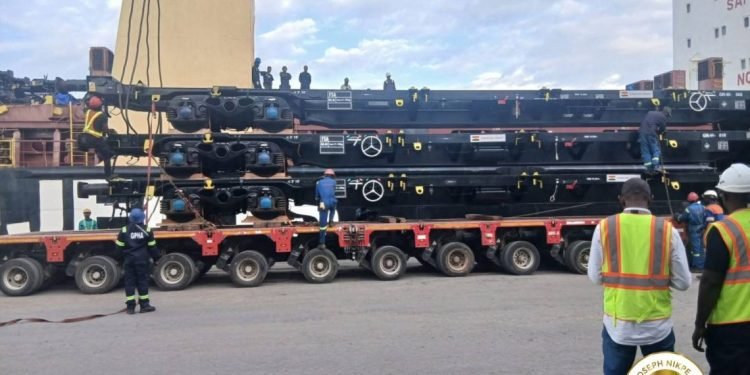

Ghana’s Ministry of Transport has confirmed the procurement of refurbished ex-Colas Rail Class 56 locomotives from the United Kingdom to support the country’s modernising railway network.
The deal brings decades-old British/Romanian engineering, machines originally built during the late 1970s and early 1980s, under Margaret Thatcher’s government, to Ghana.
Obviously and logically it makes sense because second-hand trains cost a fraction of brand-new rolling stock, the initial savings are a dangerous illusion, and the country looks like it is entering a long-term financial trap.
The reality of these purchases is stark and reads as a staggering misuse of funds. On every metric other than the initial cost, these purchases promise nothing but heartache.
The Class 56’s Ruston-Paxman 16RK3CT engine was designed in the mid-1970s. It lacks electronic fuel injection and modern emissions controls and at today’s global diesel prices, running a 3,250-horsepower engine with mid-century fuel efficiency translates to crippling daily operating costs.
The Class 56’s track record in its home country is almost tragic, even during its prime in the UK, the locomotive demanded a lot of maintenance.
Private operator Fastline abandoned its Class 56 fleet entirely after suffering chronic low availability, power failures, and catastrophic turbocharger and bogie breakdowns.
For a brand-new railway line that needs to offer reliable schedules to attract cargo clients, frequent failures are a direct threat to revenue.
Because the Class 56 has been largely phased out of mainstream UK operations, mass-produced spare parts no longer exist. When a specialized component fails on a Ghanaian line, replacement parts must be custom-machined or cannibalized from scrapped units stored in European yards.
The inevitable result: prolonged downtime and mounting costs that slowly erode any initial savings.
Interestingly, the British operators who still buy Class 56s locomotives, today only do so, for their steel chassis, then completely strip them, replacing the engine, electronics, and drivetrain with modern American components.
The result, rebranded as the Class 69, it offers modern performance at a fraction of the cost of a completely new build. Ghana, by contrast, appears to have acquired the locomotives in refurbished but largely original condition.
For a country which is still rebuilding our old narrow-gauge lines into modern standard gauge, maybe buying second-hand rolling stock offers a fast, cheap way to begin testing and light freight hauling before heavy capital becomes available.
But the economic math makes no sense; umodified Class 56s are short-term cash savers that become long-term financial liabilities.
For the price of maintaining a fleet of aging, fuel-thirsty, breakdown-prone locomotives over a decade, Ghana could have invested in a smaller number of new or comprehensively rebuilt units that would deliver reliable service, lower fuel bills, and predictable maintenance schedules.
The question is simple: can a nation investing billions in new railway infrastructure afford to power it with engines from a time before the advent of the mobile phone?
Source: asaaseradio.com